


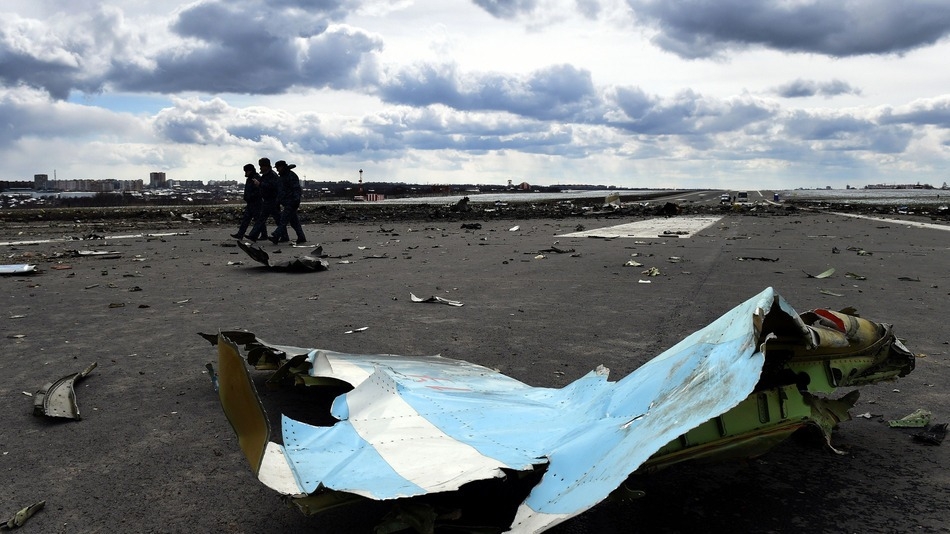
Russian investigators have disclosed that a nose-down shift in the horizontal stabiliser on the ill-fated Flydubai Boeing 737-800 occurred as a push input was recorded on the crew control yoke.
The Interstate Aviation Committee confirms a previous disclosure, by the federal air transport regulator, that the stabiliser shift occurred at a height of 900m, as the aircraft climbed away from Rostov-on-Don during a night-time go-around.
It states that “simultaneously” with the yoke being pushed in the direction away from the crew, the stabiliser deflected to a 5° nose-down position. The aircraft rapidly pitched down and dived with a pitch exceeding 50°.
“Subsequent actions of the crew could not prevent the aircraft’s collision with the ground,” says the inquiry.
It says the aircraft impacted at a speed of more than 320kt. The jet disintegrated with the loss of all 62 occupants.
Investigators have not reached conclusions over the reasons for the findings into the 19 March crash involving flight FZ981.
The jet had been climbing away with its engines at take-off setting after aborting its second approach to runway 22, at a height of 220m. Investigators have confirmed that this occurred some 4km (2.2nm) from the runway threshold.
Two hours earlier the aircraft had aborted its initial approach, at 340m, after receiving a windshear warning from the on-board systems.
Both approaches had been conducted manually, with the autopilot disengaged, the inquiry states.
The Interstate Aviation Committee has received a number of specific components from the debris on which it will carry out further research, particularly into the longitudinal control system.
Meteorological analysis indicates that the weather in the vicinity of Rostov at the time of the crash matched forecasts and that weather equipment at the airport was in working order.
Investigators have confirmed that the cloud base lay at 630m, indicating that the aircraft had entered cloud before the transition to a dive, but the inquiry has not specifically stated whether the crew would have had any visual references.
Transcription of the cockpit-voice recording is complete, says the Interstate Aviation Committee, but work on refining and translating the content, and identifying the speakers, is continuing.
The Star Alliance Lounge at Paris Charles de Gaulle Airport has been named the World’s Best Airline Alliance Lounge at the 2026 Skytrax World Airline Awards, securing the prestigious title for a...
ALSIM has announced that MH Cockpit, based in India, has acquired an AL250 simulator—marking a significant step in MH Cockpit’s expansion plans and reinforcing its ambition to build a robu...
Air France was among the leading winners at the Skytrax World Airline Awards, held in London on September 18, 2026, earning multiple distinctions that highlight the excellence of its products and cust...
Confidence in Asia's business aviation market is on the rise, according to new research commissioned by Airbus Corporate Jets (ACJ). Industry experts expect demand for business aircraft to grow st...