

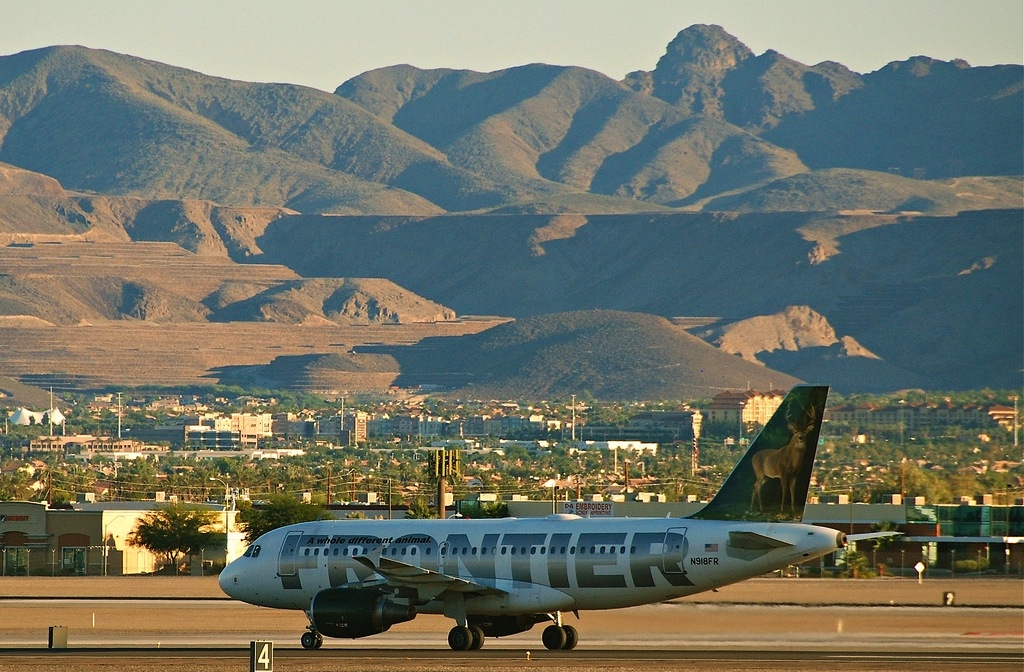
Frontier Airlines Inc., a no-frills carrier, has held early stage talks with investment banks about an initial public offering, people familiar with the matter said.
The U.S. airline is considering starting a formal IPO process as early as next year, the people said, asking not to be identified as the plans are private. There are a number of factors that could influence the decision, and Frontier may still choose not to proceed, they said.
With oil languishing close to $40 per barrel, the coming months could be seen as a favorable time to entice investors to buy shares in an airline, one of the people said. However, low ticket prices — Frontier’s tagline is “Low Fares Done Right” — have slowed revenue growth across the industry and could act as a deterrent to a deal, another person said.
Denver-based Frontier, whose planes’ tails sport images of animals like bears and foxes, was acquired by Indigo Partners in 2013. The private-equity firm, led by veteran airline executive William Franke, agreed to buy Frontier from Republic Airways Holdings Inc. for $36 million in cash, with a total transaction value of $145 million including debt. Franke is now chairman of the carrier.
Frontier spokesman Jim Faulkner declined to comment, while a representative for Indigo didn’t immediately comment.
Volaris, Virgin, Spirit
A U.S.-listed airline IPO is a rare occurrence. Only three companies have completed initial share sales in the past five years: Mexican low-cost carrier Controladora Vuela Cia. de Aviacion SAB, known as Volaris, Virgin America Inc. and Spirit Airlines Inc. Indigo bought a stake in Spirit in 2006 before the deal, and Franke was chairman of the board until 2013.
Frontier has changed hands twice since filing for bankruptcy protection in April 2008. Republic bought the carrier in October 2009 for $108.8 million, and agreed at the time not to pursue a $150 million unsecured bankruptcy claim. After the Indigo buyout, Frontier’s new owner transformed it into a so- called ultra-low cost carrier — an airline that offers inexpensive base fares and adds fees for everything else.
Airline carrier shares rallied this week after Delta Air Lines Inc. reported a 1.5 percent increase in November for revenue from each seat flown a mile, the first positive number in a year at the world’s third-biggest carrier. That helped ease concerns that the industry’s revenue is being hurt by fare cuts and increased capacity.
Stocks have also been boosted by a decline in crude oil prices, which is refined into jet fuel, and the expectation that low prices will continue into 2017. The Bloomberg U.S. Airlines Index, made up of 11 domestic carriers, has gained 103 percent from the day before Indigo acquired Frontier through Wednesday’s close in trading. This year, the measure has slumped 2.2 percent.
ExecuJet MRO Services Australia successfully completed a major 20-year scheduled airframe inspection on an Indonesian-registered Embraer Legacy 600 at its Sydney facility, further demonstrating t...
Embraer delivered the first Praetor 600E to Flexjet, marking the operator as the launch fleet customer for Embraer’s latest-generation super-midsize business jet. The inaugural aircraft joins Fl...
ALSIM has announced that MH Cockpit, based in India, has acquired an AL250 simulator—marking a significant step in MH Cockpit’s expansion plans and reinforcing its ambition to build a robu...
RECARO Aircraft Seating is celebrating the 80th anniversary of Scandinavian Airlines with a unique collection of 80 customized RECARO Gaming Nxt chairs created exclusively for the carrier. Repres...