


Hypersonics, electric propulsion, triple deckers -- think you've seen everything when it comes to new aircraft concepts?
Well just hold on a second, here comes the pod plane.
It's yet another revolutionary aircraft design, this one created by Switzerland's Federal Polytechnic Institute, that aims to transform the way people and cargo travel.
While the concept might be boundary-pushing, the inspiration is mundane.
The humble shipping container.
Futuristic and disruptive
Despite, or perhaps because of, its simple design, the shipping container is one of the most disruptive inventions of the past century.
It allows cargo to be moved cheaply from one mode of transport to another and has facilitated the development of the complex supply chains all modern economies rely on.
Transfer from truck to giant cargo ship to freight train is seamless and the container can be used again and again, drastically reducing the cost of long-distance shipping.
That's the magic of inter-modal transport -- and it's something the futuristic and potentially game-changing Clip-Air concept hopes to emulate.
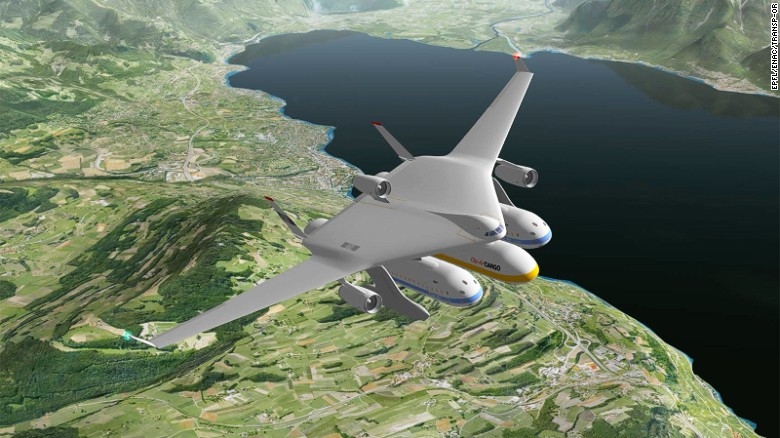
Clip-Air is composed of two elements.
There's the flying component, including airframe, cockpit and engines.
Then there's the capsules, a number of detachable pods that can act as cabin or cargo hold, depending on the chosen configuration.
The airframe is based on a flying-wing concept, reminiscent of a stealth bomber. Some may even find some similarities to the X-48, an experimental pilotless aircraft developed for NASA a decade ago.
Versatile design
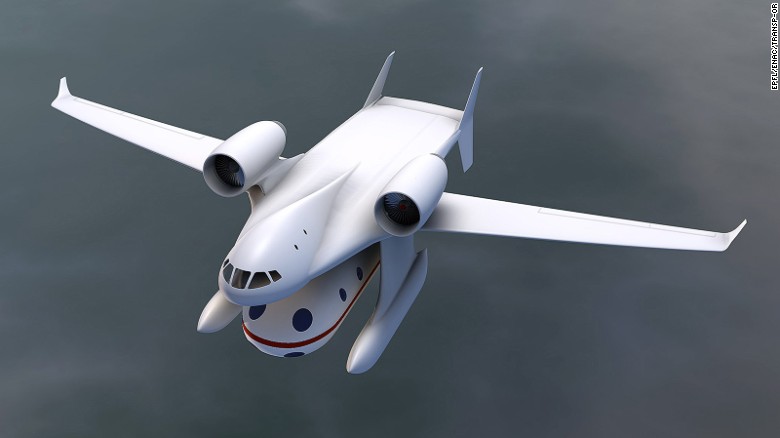
Clip-Air modules are designed to be carried by a variety of vehicles.
A pair of long metal legs protruding from each side of the flying wing, and containing the landing wheels mechanism, keep the airframe high above the ground.
The height is to allow for capsules to be hung from the belly of the aircraft, not unlike the way warplanes carry bombs and missiles.
These capsules could be made to carry either passengers or cargo.
In fact, while Clip-Air's speed and range is expected to be on a par with that of modern mid-sized airliners, the beauty of the concept rests precisely upon the versatility provided by the capsules.
These modules can be adapted to simultaneously carry a wide range of cargo and passenger combinations.
One single aircraft would be able to perform multiple roles.
The capsules can also be easily attached and detached from the airframe, making it possible for aircraft to achieve very quick rotations on the ground.
Claudio Leonardi, who manages the Clip-Air project at the Federal Polytechnic Institute in Lausanne, says this'll allow operators to maximize use of the airframe, the most expensive component.
Seamless transfer

Magic number: Up to three pods can be carried side by side.
What's more, for passengers the boarding process could become a lot faster and less stressful as they'll be able to board capsules well before the flight -- goodbye to aisle jams.
And there's the whole multi-modal aspect of the concept.
As with shipping containers, Clip-Air capsules could be seamlessly transferred onto trucks and trains, opening up a world of possibilities, not only for freight operators but also for the airline industry.
For example, there may be a decoupling of who manages the airframe and passenger cabin, or more accurately, the cabins, in plural, since up to three independent capsules could be attached to each aircraft.
Similar to what happens in the rail or shipping industry, some firms could specialize in the flying while others would focus on the passenger experience.
Passengers may even be able to choose from three different competitors, all flown by the same aircraft.
Operators could also market multi-modal itineraries that start or end well beyond the airport.
'Brilliant engineering'
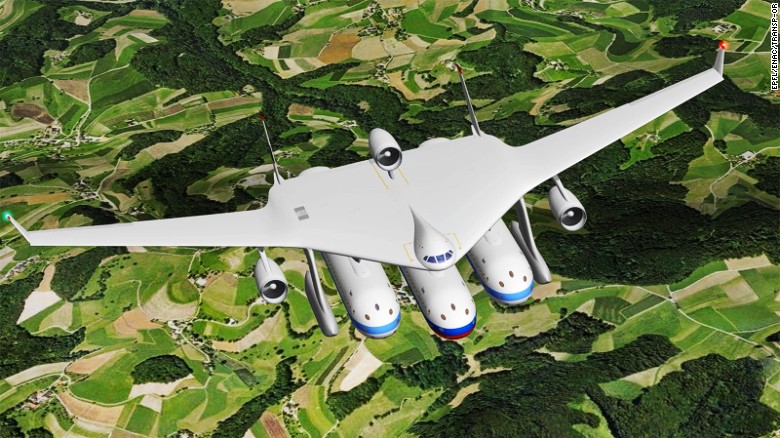
Clip-Air's designers are building a drone prototype.
Passengers might board a capsule at a local bus station and wake up in another city on the other side of the country, or planet, after a road, air and rail journey during which they didn't leave their seat.
So what are the chances of this ever happening?
Rather slim, according to Addison Schonland, founder of Airinsight, a consultancy providing market intelligence about the aviation industry.
"Although it may be brilliant from an engineering point of view, it is going to be very tough to make it work commercially," Schonland says.
"It would need to compete with proven and well-established technologies, and, frankly, it is dubious whether the market will be ready for such a radical new concept, even in the long term.
"In any case, if the concept is ever to take off, I would see it working for cargo first."
Clip-Air researchers are well aware of the challenges ahead and that years of further research and tests are needed to validate the concept.
Leonardi, however, remains adamant about his ultimate goal to build an aircraft able to fly simultaneously three capsules with the capacity to carry 150 passengers each.
"We are using only technologies and materials that are already in use and well known to the industry," he says.
Clip-Air's researchers, who are also looking into the possibility of using biofuels or liquid hydrogen as alternative fuels, have already initiated some contacts with the aerospace industry.
Obtaining support from one of the major industry players would be a game-changer.
In the meantime, Leonardi's team is preparing to build a small-scale Clip-Air prototype: a 10-meter drone, that, regardless of the long-term outlook for modular aviation, is sure to capture the imagination of onlookers and aviation visionaries alike.
Gogo Special Missions and Insitu have achieved a significant milestone in unmanned aviation with the successful testing and integration of a customized high-speed satellite communications solution for...
Riga Airport is taking the next step in the development of RIX Airport City by launching, on 22 September, the qualification stage of an international competitive dialogue to select a development part...
The year of the P.180 Avanti’s 40th anniversary has brought a second reason for celebration at Piaggio Aerospace: the sale of more than 40 P.180 Avanti EVO aircraft since the model entered servi...
Located alongside Dassault Aviation’s flagship manufacturing facility, Dassault Falcon Service Mérignac is celebrating a decade of dedicated support to Falcon operators around the world....