


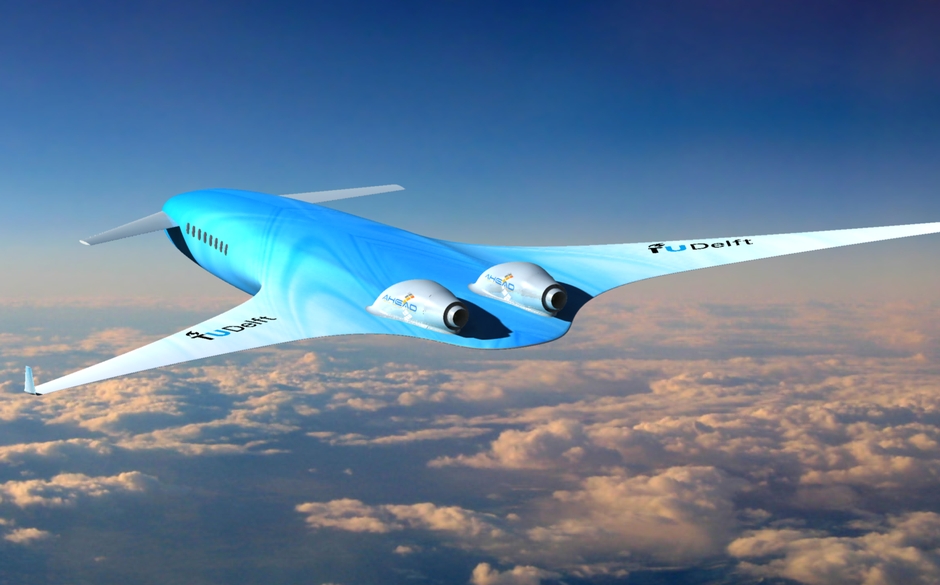
KLM's sleek and streamlined AHEAD aircraft is one of many proposed aircraft that could radically change the way we fly.
The plane of the future could well be a sleek and streamlined aircraft with a “blended wing” if proposals by the Delft University of Technology in Holland and Dutch carrier KLM come to fruition.
A blended wing is one that is seamlessly connected to the plane rather than attached separately to the fuselage and it’s one of a number of innovations that has been mooted as a result of the AHEAD study the two organisations collaborated on. Standing for Advanced Hybrid Engine Aircraft Development, the study saw academics, manufacturers and aviation experts consider how higher-tech aircraft could be developed and the aviation experience enhanced.
The prototype plane’s proposed silhouette would minimise drag and so reduce fuel consumption. A totally new engine design would provide better efficiency too, with a hybrid engine and other complicated technological amendments further finessing performance.
More precise details can be found in KLM's report on the development, but the general public is unlikely to see the results of this study in reality until about 2050. Though a long way off, it is the latest ambitious proposal for a radically different type of commercial aircraft.
Designs were released in spring for the hydrogen-powered AWWA-QG Progress Eagle, a concept plane by Barcelona-based Oscar Vinals that would harness nascent technologies to fly with zero emissions and at a volume 75 per cent quieter than today’s aircraft. The 800-passenger plane would also include a “better than first-class cabin” that could accommodate a panoramic cinema and 3D screens. Vinals’s design could, he claims, be realised by the 2030s, but a “beyond-first-class” experience is already available aboard Etihad A380 flights. The airline's Residence is a three-room suite with bedroom and bathroom that accommodates two passengers and features a dedicated butler.
Expected to commence service in the 2020s, a number of commercial supersonic aircraft are currently being developed by NASA and others too. Topping Concorde speeds, some could – engineers claim – fly from London to Sydney in an afternoon. Though being developed by different companies, a number of the aircraft share a common proposed innovation: windowless cabins.
By removing windows the aircraft would succumb to less drag and so could reach enhanced speeds. In their place, screens that curved around the interior of the cabin could broadcast footage from outside via cameras or be used to display films, presentations or whatever other footage was desired by the select few inside.
ExecuJet MRO Services Australia successfully completed a major 20-year scheduled airframe inspection on an Indonesian-registered Embraer Legacy 600 at its Sydney facility, further demonstrating t...
Confidence in Asia's business aviation market is on the rise, according to new research commissioned by Airbus Corporate Jets (ACJ). Industry experts expect demand for business aircraft to grow st...
Air France was among the leading winners at the Skytrax World Airline Awards, held in London on September 18, 2026, earning multiple distinctions that highlight the excellence of its products and cust...
KlasJet has achieved a significant milestone by obtaining Part 129 Operations Specifications (OpSpecs) approval from the FAA, paving the way for the company's expansion into the U.S. market. As pa...