


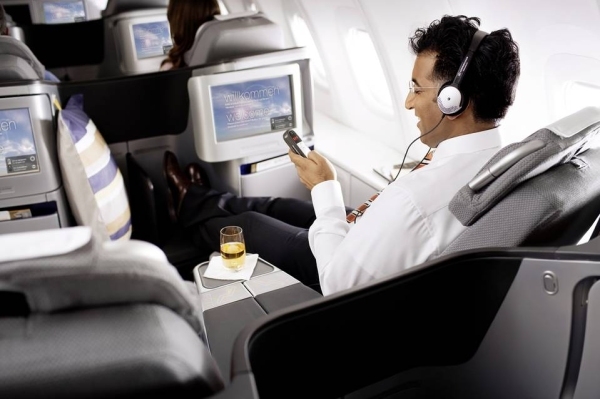
High-speed internet access via smartphones could become a feature on European airline flights following a deal involving the German carrier Lufthansa - but voice calls will be blocked at first.
Lufthansa will offer Wi-Fi on its short- and medium-haul flights from 2017, provided by the satellite firm Inmarsat and Deutsche Telekom.
The companies claim their venture, which combines ground-based mobile broadband networks and the nascent satellite networks already used on some planes, will permit a more reliable, faster connection than passengers currently experience. Although Lufthansa is the only airline trialling the network so far, Inmarsat and Deutsche Telekom claim it will eventually provide sufficient capacity for planes across Europe's flightpaths.
Airlines have focused on offering Wi-Fi connectivity on long-haul flights, but the services have been a long way from replicating the broadband speeds on the ground. One European airline, Norwegian, offers free Wi-Fi aboard its planes.
Lufthansa is to start rolling out broadband internet access to passengers on its planes from next year using existing satellite connectivity, but Carsten Spohr, the airline's chief executive, said they were thinking further ahead: "We want to engage in the development of next-generation technology."
"The provision of reliable, consistent broadband connectivity aboard our planes, which will match that of high-speed home broadband in terms of speed and quality, is of extreme importance to us."
Spohr suggested passengers would be able to book flights or order groceries for home delivery after they land - but will probably block Skype-style calls that would disturb neighbouring passengers. The price of using onboard Wi-Fi is likely to be linked to the ticket price and class of travel, with benefits for frequent travellers.
Deutsche Telekom will build a new mobile broadband network of approximately 300 masts with a far greater range than most conventional sites, able to transmit data over a range of 80km and to the operating altitude of passenger planes. Once the plane is at an altitude of more than 10,000 feet, the ground-based network would work alongside Inmarsat's satellite, which would in effect fill in gaps in the coverage - with switching between signals managed in the plane.
While most inflight Wi-Fi has been slow, the industry sees it as a major attraction to lure customers onboard. However, the prospect of high-speed internet access to facilitate communication in the sky has not been universally welcomed.
A U.S. government watchdog recently warned that onboard Wi-Fi could enable hackers on commercial flights to bring down the plane. Its Accountability Office said that would-be attackers could exploit new vulnerabilities: "This interconnectedness can potentially provide unauthorised remote access to aircraft avionics systems."
ALSIM has announced that MH Cockpit, based in India, has acquired an AL250 simulator—marking a significant step in MH Cockpit’s expansion plans and reinforcing its ambition to build a robu...
RECARO Aircraft Seating is celebrating the 80th anniversary of Scandinavian Airlines with a unique collection of 80 customized RECARO Gaming Nxt chairs created exclusively for the carrier. Repres...
flydubai has strengthened its pilot development strategy through new partnerships with Egnatia Aviation and Skyborne Airline Academy, aimed at expanding the airline's training capacity and support...
Embraer delivered the first Praetor 600E to Flexjet, marking the operator as the launch fleet customer for Embraer’s latest-generation super-midsize business jet. The inaugural aircraft joins Fl...