


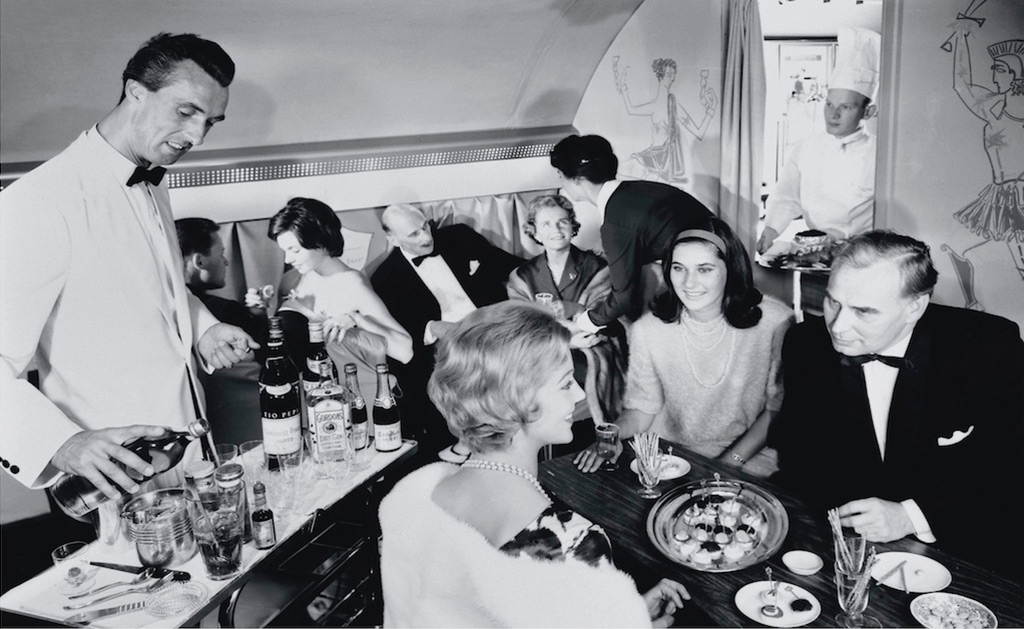
Today’s airlines make a fuss about the quality of their first-class amenities, boasting about lounges, chauffeured cars to and from the airport, lie-flat beds, big screen TVs, and chef-prepared meals served on real (!) plates.
While those might be exciting for the six hours that passengers are airborne (upon landing, the thrill of sleeping horizontally packs less of a punch), they are not, as airlines’ marketing departments would have you believe, a new phenomenon. According to a new book from Assouline, The Art of Flying, which was created in partnership with the private charter service Vista Jet, what we consider cutting-edge first-class amenities are almost as old as flying itself.
Almost.
There certainly wasn’t an en-suite shower at Kitty Hawk. Even after World War I, when commercial flying began to (ahem) take off, most flights, we’re told in Josh Condon’s introduction to his book, were subsidized by mail and cargo transportation. The practice continues today, although much less intrusively. “It was common for early air travelers to sit amid—or even on—bags of mail stacks of leather, or carts of Devonshire cream and other exports,” Condon writes. The book casually informs us that pilots would often carry guns “to protect the mail.”
Things Picked Up Fast
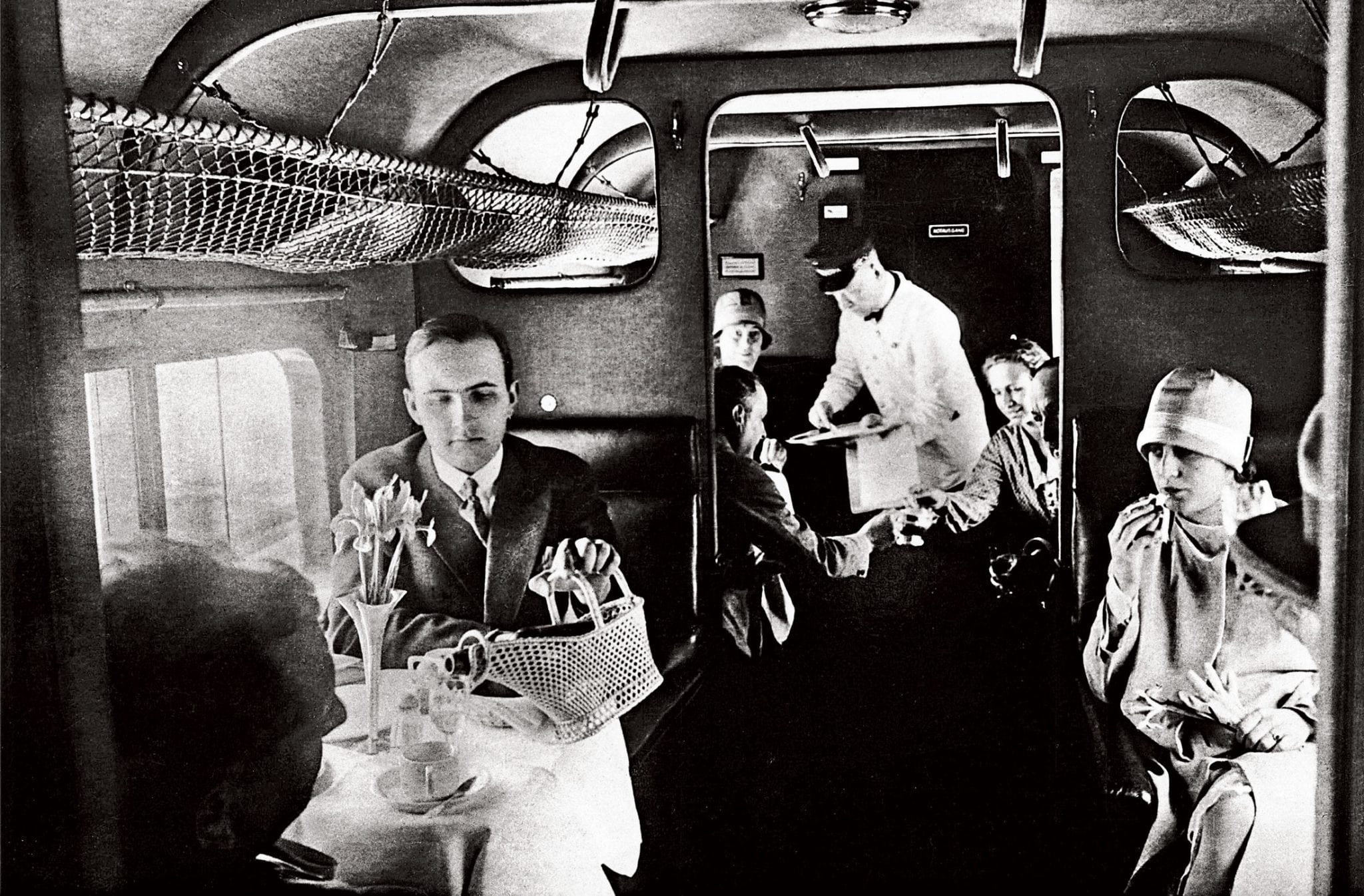
As airplanes emerged as a viable alternative to ocean and rail travel, they did their best to mimic, reassuringly, the aesthetic accents of boats and trains. Above, the 1928 interior of a Luft Hansa (a precursor to Lufthansa) plane features tablecloths and floral arrangements; the overhead storage space looks reassuringly like that of a railcar.

Nothing Says “Safety” Like Club Chairs
Similarly, an open-seating arrangement from 1930 bears resemblance to a stateroom on a boat. The book also notes that airlines had already begun to offer services beyond mere flying. Western Air (now part of Delta), we are told, provided a chauffeured Cadillac to and from the airport. In a precursor to airport lounges, Crilly Airlines provided private offices for business meetings. And KLM built its own restaurant at Schiphol Airport.
It Was a Simpler Time
Quoting from Julian Pettifer and Kenneth Hudson’s book, Diamonds in the Sky: A Social History of Air Travel, the Assouline tome notes that a dinner served on the Empire flying boat in the 1930s could include pâté de foie gras or grapefruit; roast chicken, ox tongue and York ham, with Russian salad or green salad; peaches and sauce melba; golden figs; Cheshire, Camembert and Kraft cheese; ‘toast Imperial’; biscuits; dessert; and coffee.
The Only Difference Between Now and Then
The ratio of staff to passengers was much higher in the heyday. Otherwise, even what we consider 21st century amenities are close to 90 years old. The earliest in-flight entertainment came in 1925, according to the book, with a KLM steward operating a hand-cranked film projector. By the 1950s, planes had fully functional lounges such as the Lufthansa Senator service (at the top of this page).
Pressurized Interiors Upped the Ante
Until the 1950s, planes flew low enough that passengers could (and often did) open a window to let in a breeze. With the advent of technology developed during World War II, pressurized cabins allowed planes to fly much higher with far less turbulence. The downside was that windows had to be sealed.

Flying the Chauvinist Skies
Female flight attendants were, the book tells us, “unheard of before 1930”; luxury service was considered a man’s job. (The first stewardesses were registered nurses who wore medical uniforms during flight.) By the time Braniff commissioned Emilio Pucci to design his now-iconic uniforms in 1965, the tables had turned.
The Bars and Cubbies of Today
In context, today’s first-class cubbies don’t seem so spacious, though some stylistic similarities are clear. Note the small lamp in the contemporary first-class cabin from Emirates (left), and then review the train-car-like interior from the 1930s.
Similarly, the first-class bar just above looks to be slightly less fun than the 1950s Lufthansa version.

The Airplane of Tomorrow
Even concept airplanes look eerily like seaplanes of yesteryear. Compare the futuristic mock-interior of the Spike Aerospace S-512, which its makers say will travel at Mach 1.6. Notice any similarity to the wide, train-like windows and club chairs above? Thought so.
The Star Alliance Lounge at Paris Charles de Gaulle Airport has been named the World’s Best Airline Alliance Lounge at the 2026 Skytrax World Airline Awards, securing the prestigious title for a...
Riga Airport is taking the next step in the development of RIX Airport City by launching, on 22 September, the qualification stage of an international competitive dialogue to select a development part...
Located alongside Dassault Aviation’s flagship manufacturing facility, Dassault Falcon Service Mérignac is celebrating a decade of dedicated support to Falcon operators around the world....
KlasJet has achieved a significant milestone by obtaining Part 129 Operations Specifications (OpSpecs) approval from the FAA, paving the way for the company's expansion into the U.S. market. As pa...