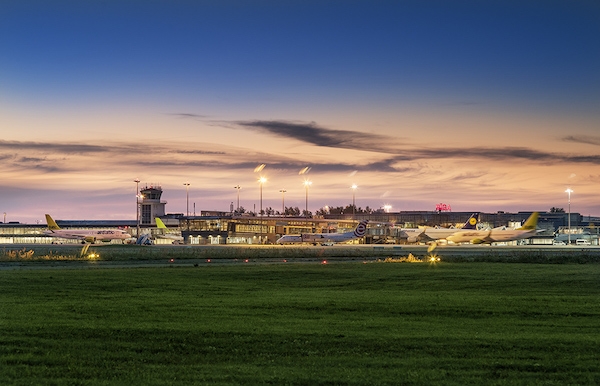


Demonstrating the reduction of carbon emissions and confirming its readiness to work sustainably, Riga Airport has received the Level 2 certificate of the global Airport Carbon Accreditation (ACA) programme. Certification for Level 2 “Reduction” of the ACA programme means that Riga Airport has demonstrated a reduction in carbon emissions relative to the average emissions of the previous three years and has proven its readiness to work sustainably and continue to work purposefully to reduce carbon emissions.
The ACA programme is the only airport-specific carbon reduction programme in the world, the certificate of which confirms airport's strategic direction towards sustainable development and mitigation of climate change. Airports, which serve 67.4% of passengers in Europe and 45.1% worldwide, have joined the ACA programme at various levels.
"Sustainability, with the environment as one of its key aspects, must be at the heart of any company's business today. Riga Airport works on these issues in a planned and purposeful manner, implementing its economic activities in such a way as to create as little impact on the environment as possible, but if such an impact exists, to minimize its consequences. By participating in the ACA programme and complying with its guidelines, the goal of Riga Airport is to certify for an ever-higher level of accreditation, ultimately reaching net zero level emissions,” says Laila Odiņa, Chairperson of the Board of Riga Airport.
NetZero2050 is an integral part of the Airport Council International (ACI Europe) Airport Sustainability Strategy, which is also closely linked to the European Union's (EU) Green Course and commitment to climate neutrality by 2050. The ACA programme was established in 2008, ten years before the EU announced its Green Course. This was during ACI Europe's 18th annual congress, when European airports pledged to reduce CO2 emissions to achieve their ultimate goal of becoming carbon neutral.
In the first year, only 17 airports were accredited in the programme, whereas currently 330 airports from all over the world participate in it, 163 airports in Europe, five in the Baltic States.
Initially, the programme had four levels: Mapping, Reduction, Optimisation, Neutrality, but since this November the programme has been supplemented with two new levels - Transforming and Transition.
Riga Airport joined the programme at the same time as Vilnius Airport and until 2019 they were the only carbon management programme certified airports in the Baltic States. Palanga, Kaunas and Tallinn airports joined the programme in 2019.
Embraer delivered the first Praetor 600E to Flexjet, marking the operator as the launch fleet customer for Embraer’s latest-generation super-midsize business jet. The inaugural aircraft joins Fl...
Air France was among the leading winners at the Skytrax World Airline Awards, held in London on September 18, 2026, earning multiple distinctions that highlight the excellence of its products and cust...
flydubai has strengthened its pilot development strategy through new partnerships with Egnatia Aviation and Skyborne Airline Academy, aimed at expanding the airline's training capacity and support...
Confidence in Asia's business aviation market is on the rise, according to new research commissioned by Airbus Corporate Jets (ACJ). Industry experts expect demand for business aircraft to grow st...