


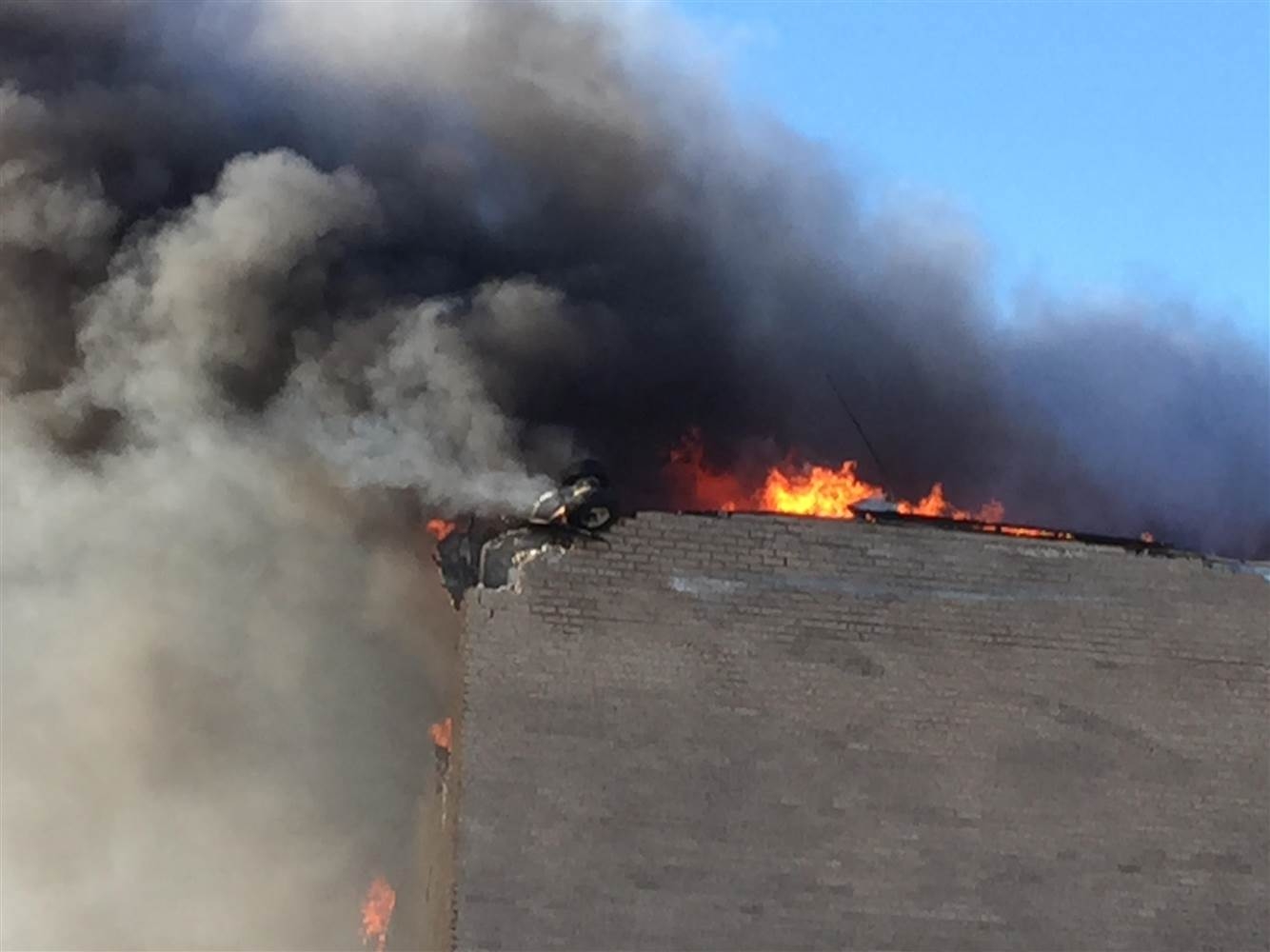
The pilot and sole occupant of a King Air 200 that crashed into a FlightSafety International (FSI) simulator building at Wichita Mid-Continent Airport (ICT) on Oct. 30, 2014 responded incorrectly to a decrease in power from the twin turboprop’s left engine on takeoff, according to the NTSB’s probable cause report.
The aircraft was headed to Mena Intermountain Municipal Airport (MEZ) in Mena, Ark. Shortly after departing from Runway 1R at Wichita, the pilot declared an emergency and told controllers the aircraft had “lost the left engine.” The aircraft then entered a shallow, descending left turn, with airport surveillance camera footage indicating it was in a nose-left sideslip as it overflew a hangar immediately before impact.
The aircraft subsequently struck the FSI building, killing the pilot and three people inside the simulator facility and injuring six more. A severe post-impact fire ensued. Data retrieved from an onboard cockpit voice recorder showed total flight time from takeoff to impact was 26 seconds.
A Wichita-based service facility had recently completed major maintenance on the aircraft, including left and right engine hot-section inspections and an overhaul of the right propeller. The airplane had accumulated 1.4 hours and two cycles since it was initially released to service on October 22. Two discrepancies were noted during the first post-maintenance test flight, including a misaligned left throttle lever that was slightly skewed ahead of the right lever. The mismatch was corrected, and a high pressurization leakage rate was found to be within acceptable parameters. The aircraft was returned to service after a subsequent test flight on October 27.
Post-accident examination of the wreckage did not indicate any anomalies, with investigators noting that neither propeller was feathered before impact. Damage signatures indicated that both engines were operating before the accident, with analysis of propeller blade angles and sound spectrum analysis further revealing that the left engine “was likely producing low to moderate power and that the right engine was likely producing moderate to high power” on impact with the building.
Although most of the aircraft was destroyed in the crash, the NTSB determined that available evidence indicated the pilot failed to follow emergency procedures for an engine failure during takeoff, including landing-gear retraction and feathering the propeller on the affected engine.
Investigators also noted that the ATP-rated pilot, who as of September 2014 had reported more than 3,000 hours of flight time in a variety of turbine aircraft, suffered from anxiety and depression that he was treating with medication that he had not reported to the FAA. No evidence could be found that this contributed to his inability to control the airplane in an emergency, however.


Air France was among the leading winners at the Skytrax World Airline Awards, held in London on September 18, 2026, earning multiple distinctions that highlight the excellence of its products and cust...
flydubai has strengthened its pilot development strategy through new partnerships with Egnatia Aviation and Skyborne Airline Academy, aimed at expanding the airline's training capacity and support...
Confidence in Asia's business aviation market is on the rise, according to new research commissioned by Airbus Corporate Jets (ACJ). Industry experts expect demand for business aircraft to grow st...
ExecuJet MRO Services Australia successfully completed a major 20-year scheduled airframe inspection on an Indonesian-registered Embraer Legacy 600 at its Sydney facility, further demonstrating t...