


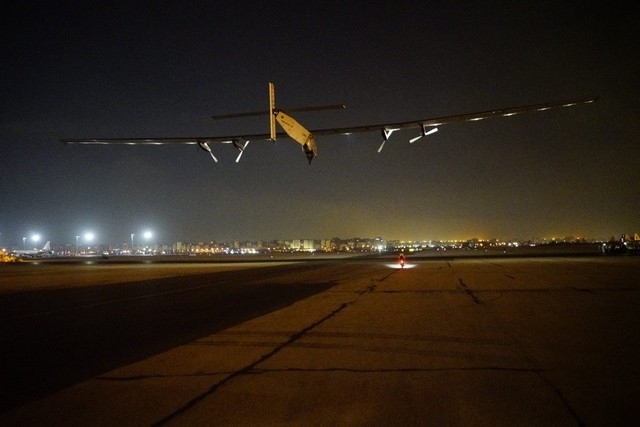
Solar impulse 2 has taken off for the final time on its historic round-the-world trip using nothing but the power of the sun.
Piloted by the project’s co-founder, Bertrand Piccard, Solar impulse 2 left Cairo at 3am UAE time and is expected to arrive in Al Bateen Airport in Abu Dhabi on Tuesday.
Mr Piccard, who initiated the project 12 years ago, said Egypt was where he first began thinking of making a circumnavigation using only solar power.
"I’m excited to come so close to the goal, but unfortunately there are still so many people we have to motivate before having a world running on the same clean technologies," Mr Piccard said.
The Masdar-sponsored plane first began its round-the-world journey in Abu Dhabi in March 2015.
Mr Piccard dedicated his first flight to Sheikh Mohammed bin Zayed, Crown Prince of Abu Dhabi and Deputy Supreme Commander of the Armed Forces, who he met 12 years ago. He said the UAE has been a stalwart support for his adventure.
"Today, we are living the final moments of a once in a lifetime adventure contributing to setting a new milestone in aviation — one centred not on speed or height, but instead on exploring new clean and efficient technologies that can almost make it possible for the plane to fly with unlimited endurance, a week, a month; something that was never done," said André Borschberg, the project’s co-founder and co-pilot.
The final leg of the journey is expected to be as challenging as the previous 16, mostly due to the heat in the Middle East. The hot temperatures will test the limits of the plane and can cause thermals and turbulence, forcing Mr Piccard to wear an oxygen mask for extended periods of time.
"We have never had to deal with temperatures so high before on our round-the-world tour, but a little challenge at the end of our mission is always good," Solar Impulse said on its blog.
The plane has been piloted by Mr Piccard and Mr Borschberg with stops in 16 cities to raise awareness on the viability of renewable energy.
The flights across the Pacific and Atlantic each took five days to complete each, pushing the pilots to their physical limit as they flew the Solar Impulse 2 solo.
"The question isn’t the plane," said Mr Borschberg in April, "It’s the question of the pilots being in the right physical and mental state to complete the flight."
The Solar Impulse’s final flight to Abu Dhabi was delayed in Cairo last week due to a last-minute turn in weather conditions.
Ground crew in Cairo airport were well under way for the take-off but the Solar Impulse team said the last wind reading was too high for the plane to take off safely.
Adding to the unfavourable wind conditions, Mr Piccard was suffering from an upset stomach that would have been problematic over the expected two to three-day flight.
Confidence in Asia's business aviation market is on the rise, according to new research commissioned by Airbus Corporate Jets (ACJ). Industry experts expect demand for business aircraft to grow st...
flydubai has strengthened its pilot development strategy through new partnerships with Egnatia Aviation and Skyborne Airline Academy, aimed at expanding the airline's training capacity and support...
Air France was among the leading winners at the Skytrax World Airline Awards, held in London on September 18, 2026, earning multiple distinctions that highlight the excellence of its products and cust...
ALSIM has announced that MH Cockpit, based in India, has acquired an AL250 simulator—marking a significant step in MH Cockpit’s expansion plans and reinforcing its ambition to build a robu...