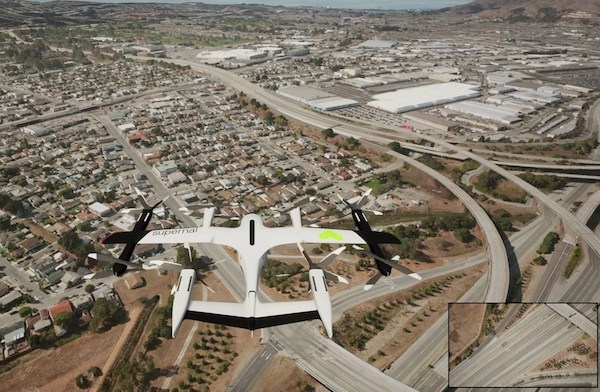


Supernal announced a collaboration with Microsoft to advance autonomy, digital operations and cloud integration technologies for the aviation industry by running Advanced Air Mobility on the Microsoft cloud platform. With Microsoft Azure, Supernal can leverage the flexibility and cloud computing power needed to run secure simulations at scale and accelerate its timeline to commercialization. Microsoft benefits from Supernal's deep industry insights and experiences to enhance its customer-driven product innovation, including further enabling AAM companies to test and train simulations.
Dr. Jaiwon Shin, president of Hyundai Motor Group and CEO of Supernal, commented: "In ushering in a new frontier of transportation with Advanced Air Mobility, Supernal has an obligation to ensure safe and secure deployment of eVTOL vehicles. We are pleased to collaborate with Microsoft, a software leader, in responsibly advancing AAM autonomous systems and information-sharing."
Ulrich Homann, corporate vice president Cloud + AI at Microsoft said: "Air transport is a key pillar in the democratization of mobility, connecting more people, goods and places through safe flight experiences. With the Microsoft Cloud, Supernal can unlock the computing power it takes to build, validate, and deploy electric air vehicles at scale, spurring the commercialization of advanced air mobility solutions."
During the initial phase of the collaboration, Microsoft will provide Supernal early access to Project AirSim, an artificial intelligence (AI)-first simulation platform, to safely build, test, train and validate autonomous aircraft transportation through simulation. Project AirSim uses Azure to generate significant amounts of environment and sensory data to train machine learning models that simulate all phases of flight and variable weather patterns. Project AirSim provides libraries of pretrained AI models and planet-scale 3D environments representing urban and rural landscapes, as well as a partner ecosystem offering synthetic data generation to help accelerate aerial autonomy.
In addition, Supernal is looking to use the Microsoft mixed-reality headset—HoloLens 2—to create augmented reality (AR) applications for future vehicle and manufacturing operations. AR resources could enable efficiencies in future AAM manufacturing and maintenance by providing technicians visual feedback during routine actions and bring engineering support virtually on-site.Microsoft is a critical ecosystem partner for Supernal to usher complete smart city infrastructure to markets, creating a seamless approach to the customer journey.

Haffner Energy is redefining the economics of renewable fuels with the launch of SB-HEFA (Solid Biomass to HEFA), an innovative technology that converts solid biomass directly into liquid feedstock th...
TARMAC Aerosave, Europe’s leading provider of aircraft storage, maintenance and recycling services, announced today at MRO Asia-Pacific 2026 that it has received approval (IND.FAMO.0000000129) f...
ExecuJet MRO Services Australia successfully completed a major 20-year scheduled airframe inspection on an Indonesian-registered Embraer Legacy 600 at its Sydney facility, further demonstrating t...
Collins Aerospace has been selected by Royal Brunei Airlines to provide its FlightSense™ and DispatchSM services under two 12-year agreements supporting the ca...