


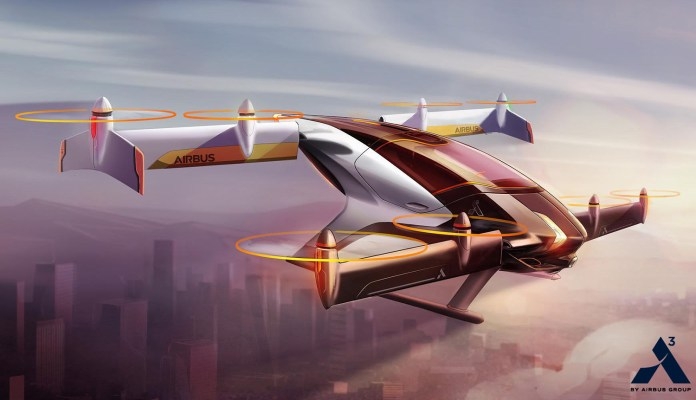
We’ve already got self-driving cars, so surely the next obvious move is self-flying taxis, right? That’s exactly what Airbus, the European aerospace giants have set out to do with Vahana. This autonomous flying plane will get you where you want to go twice as fast as any car and can fly a single passenger up to 50 miles at a time.
At first, the company was unsure whether to make Vahana an electric helicopter or a plane that had tiltable wings that enabled a vertical take-off and landing (VTOL). However, they have now decided and announced their plans to build a tilt-wing plane and start testing before the end of the year. “The vehicle is being built. Parts are being made as we speak”, says Geoffrey Bower, Airbus chief engineer. But, there’s still a long way to go before we are seeing these machines. However, the company is aiming to get air taxis in place within the next ten years, so it’s not a million miles away.
The Vahana looks different to most other small planes you see as it has two sets of wings and can fly straight up and down. There are eight propellers in total on the wings giving it the look of a helicopter on ascent and descent and will also be equipped with a parachute in case of an emergency. The plane eventually won the argument over a helicopter as it’s cheaper to run on longer flights and can travel much, much further for the same weight and battery power as the helicopter. Designed to carry just a single passenger on a short, trip, The Vahana is based on the same idea as NASA’s planes. Therefore it should be extremely efficient.

The Vahana flies like a plane, with wings and propellers facing forward, for most of its time in the air.

The Vahana is meant to carry a single passenger on short, inexpensive flights when time is too tight to drive.
Bower says, “Internal combustion engines or turbines have heavy [drive] shafts that take power out to rotors that are distributed far away. That’s even more challenging for rotors or wings that pivot for vertical flight. Spacing electric motors around the aircraft – known as distributed electric propulsion – just require running wires to them. It also helps that electric motors are two to three more efficient than internal combustion engines.”
But, CAFE (Comparative Aircraft Flight Efficiency) Foundation executive director Yolanka Wulff, says that the biggest barrier for the Vahana isn’t the plane, but infrastructure around it. Landing pads will need to be scattered about urban environments and costs will need to be no more than around $40 for a 15-minute flight. But, if all that can be adhered to there’s no reason why the Vahana and any similar projects should not be a huge success. I for one would certainly be willing to try it out, and get where you need to be in half the time, wouldn’t you?
ExecuJet MRO Services Australia successfully completed a major 20-year scheduled airframe inspection on an Indonesian-registered Embraer Legacy 600 at its Sydney facility, further demonstrating t...
The Star Alliance Lounge at Paris Charles de Gaulle Airport has been named the World’s Best Airline Alliance Lounge at the 2026 Skytrax World Airline Awards, securing the prestigious title for a...
ALSIM has announced that MH Cockpit, based in India, has acquired an AL250 simulator—marking a significant step in MH Cockpit’s expansion plans and reinforcing its ambition to build a robu...
Confidence in Asia's business aviation market is on the rise, according to new research commissioned by Airbus Corporate Jets (ACJ). Industry experts expect demand for business aircraft to grow st...