


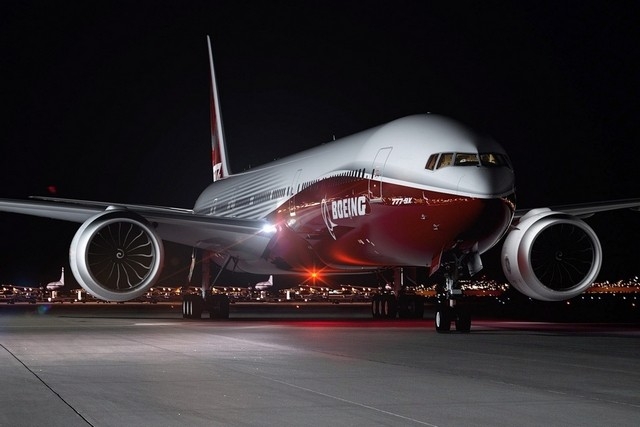
Pilots on Boeing’s 777X jetliner will soon be able to use a swipe of the finger to plot a course around a threatening storm or check an engine’s maintenance history.
The Chicago-based plane maker has chosen Rockwell Collins to provide the first touchscreen monitors to be installed in a commercial aircraft. When Boeing’s largest twin-engine plane debuts in 2020, pilots will hone in on flight data on the jet’s five displays with a pinch-to-zoom motion – much like Apple’s iPad has brought a world of information to consumers.
Rockwell Collins is counting on the screens and the data flowing through them to boost sales and improve pilots’ situational awareness as modern planes turn into flying file servers. The touchscreens are also designed to make flight displays more intuitive while shaving weight from airframes.
"Airplanes were one of the last places that were disconnected, but no longer," said the Rockwell Collins chief executive Kelly Ortberg. "It’s happening to all of us in the mobile world. You could see it was going to sweep our world as well."
Rockwell Collins stock has dropped 11 per cent this year through Tuesday as tepid business-jet sales and a slow rebound in US government spending held back earnings.
The aerospace manufacturer is counting on a late-decade pay-off from contract wins to install large flight displays and other electronic systems on Boeing’s next-generation aircraft, from the 787 Dreamliner to the 737 Max. Honeywell International, Thales and Garmin are also competing for supremacy to bring new innovations to pilots’ fingertips.
They face a common rival in the iPad itself and ecosystems of developers catering to recreational pilots. ForeFlight, for example, has developed maps and "synthetic vision" to help to steer around hazardous terrain with a tap of an Apple or Android tablet hooked into a plane’s GPS and ADS-B tracking systems.
The new Rockwell Collins products are the culmination of a strategy plotted by then-chief executive Clay Jones and Mr Ortberg early last decade, when smartphones and tablets were in their infancy. Following a painful defence contract loss, the manufacturer adopted a flexible "open" architecture for its systems to win over customers such as Boeing. Its US$1.39 billion acquisition of Arinc in 2013, just 11 days after Mr Ortberg took the helm, was the company’s largest and provided new ways to pipe data into aeroplanes.
While Rockwell Collins is scouting smaller deals, Mr Ortberg is open to another bold move as he charts a course toward a world of smart planes and connected pilots.
"If another Arinc came along, I’d love to be in a position to do that," he said. "We’re keeping our credit rating at investment grade so we have the financial capability to do that."
Air France was among the leading winners at the Skytrax World Airline Awards, held in London on September 18, 2026, earning multiple distinctions that highlight the excellence of its products and cust...
TARMAC Aerosave, Europe’s leading provider of aircraft storage, maintenance and recycling services, announced today at MRO Asia-Pacific 2026 that it has received approval (IND.FAMO.0000000129) f...
flydubai has strengthened its pilot development strategy through new partnerships with Egnatia Aviation and Skyborne Airline Academy, aimed at expanding the airline's training capacity and support...
The Star Alliance Lounge at Paris Charles de Gaulle Airport has been named the World’s Best Airline Alliance Lounge at the 2026 Skytrax World Airline Awards, securing the prestigious title for a...