


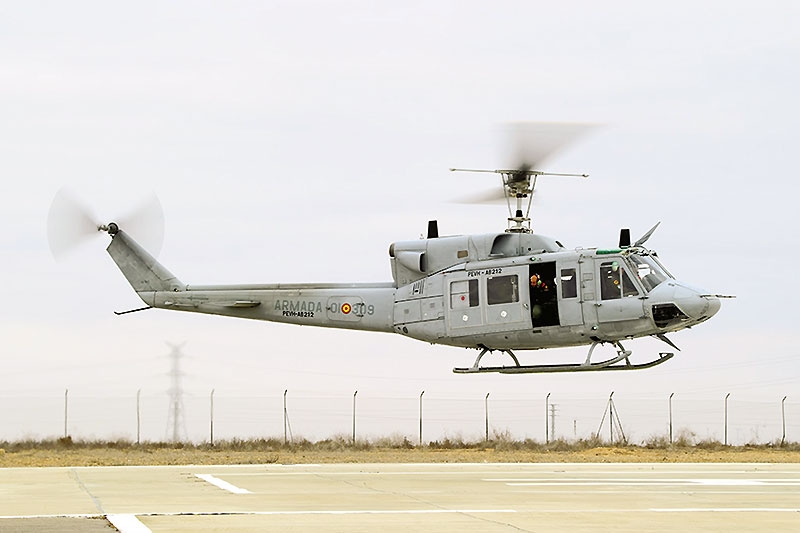
The SENER engineering and technology group, in a joint venture with INAER, the main helicopters operator in Spain, has delivered the first Agusta Bell 212 (AB212) helicopter to the Directorate-General of Armament and Material (DGAM) of the Spanish Ministry of Defense, after completing the first phase of its modernization that will extend the operational life of seven AB212 helicopters by at least another 15 years.
The SENER-INAER joint venture is responsible for the life extension program by incorporating advancements in equipment and avionics. In the joint venture, SENER has led the design, engineering and integration works, while INAER has led the installation and certification works.
According to the head of the SENER-INAER joint venture, the SENER engineer Fernando Quintana, “the modernization of the AB212 is an ambitious program, the first of its kind in the Spanish aeronautical industry, which will significantly improve the performance of these helicopters by incorporating new capacities such as radar, a night vision system, protection and self-defense systems, etc. The AB212 are helicopters ready to operate effectively in ever more demanding national and international contexts. This initiative has implied a much lower cost for the Spanish Navy than that of replacing them with new models with similar capacities.”
In this sense, Jorge Arnás, INAER’s Director of Desing and Integration, highlighted that “this ambitious project shows once again INAER’s compromise with the Armed Forces that, in this occasion, has been put at the service of the Spanish Ministry of Defense for the recondition of the AB212 helicopters. This collaboration guarantees the fine tuning of the aircrafts under the most demanding quality standards, extending their operational life and their capability for providing service with total security.”
This life extension program, as well as completely replacing the electrical system and the analogue cockpit for a completely digital one, involves the incorporation of state-of-the-art mission systems such as EFIS, EO/IR radar, Automatic Identification System (AIS), GPS navigation system, TAWS, Tactical Mission Controller (TMC), cargo crane, modifications to the auxiliary fuel tanks, a missile approach warning system (MAWS), a ballistic protection system in the flight and passenger cabin, armored and anti-crash seats for the crew, and defense weapon systems. It also includes the addition of plug-in technology that will allow the helicopters to be quickly reconfigured for new missions.
This way, the helicopters will be able to operate without restriction in controlled military and civilian airspaces, in accordance with the requirement of new regulations, as well as giving them self-protection and defense systems that will allow them to be deployed in multinational missions with a low-medium threat level.
Air France was among the leading winners at the Skytrax World Airline Awards, held in London on September 18, 2026, earning multiple distinctions that highlight the excellence of its products and cust...
Embraer delivered the first Praetor 600E to Flexjet, marking the operator as the launch fleet customer for Embraer’s latest-generation super-midsize business jet. The inaugural aircraft joins Fl...
Confidence in Asia's business aviation market is on the rise, according to new research commissioned by Airbus Corporate Jets (ACJ). Industry experts expect demand for business aircraft to grow st...
ExecuJet MRO Services Australia successfully completed a major 20-year scheduled airframe inspection on an Indonesian-registered Embraer Legacy 600 at its Sydney facility, further demonstrating t...