


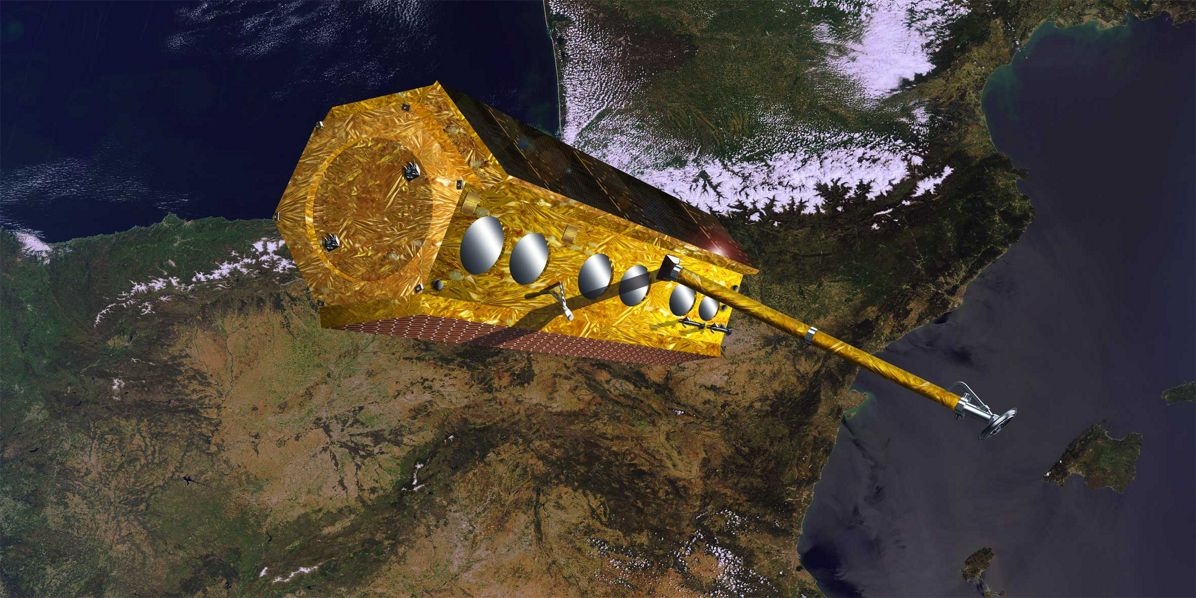
Spain’s first radar satellite will be shipped next month to Vandenberg/USA ready for launch on 30 January 2018
The high resolution radar, Earth observation PAZ satellite, intended primarily to address civilian surveillance needs and to cover many different applications including defence and security, will say its final goodbye to Spain. It will be shipped in December 2017 to its launch site in Vandenberg Air Force Base, California, USA.
Airbus and Hisdesat, the Spanish operator of governmental satellites announce that the launch of the PAZ satellite will take place in the last week of January. Since completion in 2015, Airbus has maintained the satellite in its Barajas cleanrooms, in Madrid, ready to be launched at short notice. “We had to be ready at all times as we could have got a green light at any moment,” said José Guillamón, head of Airbus Space Systems in Spain. Close cooperation between Airbus as the prime contractor and Hisdesat as the owner and operator of the satellite has been a key factor in successfully reaching the final stages.
The PAZ satellite is equipped with an advanced radar instrument designed for high flexibility, and the capability to operate in numerous modes allowing for the choice of several different image configurations. It will be able to generate images with up to 25 cm resolution, day and night and regardless of the meteorological conditions. Designed for a mission of five and a half years, PAZ will orbit Earth 15 times per day, covering an area of over 300,000 square kilometres from an altitude of 514 kilometres and a velocity of seven kilometres per second. On its slightly inclined quasi-polar orbit, PAZ will cover the entire globe in 24 hours, serving both government and commercial needs.
PAZ also features a sophisticated Automatic Identification System (AIS), simultaneously combining for the first time ship AIS signals and SAR (Synthetic Aperture Radar) imagery, increasing the monitoring capacities of the maritime domain worldwide. It will also be equipped with a Radio Occultation and Heavy Precipitation experiment (ROHP) from the Institute of Space Science del Consejo Superior de Investigaciones Científicas (ICE-CSIC). For the first time ever, GNSS (Global Navigation Satellite System) Radio Occultation measurements will be taken at two polarizations, to exploit the potential capabilities of polarimetric radio occultation for detecting and quantifying heavy precipitation events.
Airbus in Spain, as prime contractor of the programme, led a team of 18 European companies. The Spanish space industry was heavily involved in the development of the advanced active sensor with SAR technology. Since the start of the programme, the PAZ satellite has been generating significant benefits for the Spanish space companies involved, allowing them to develop new capabilities to further enhance their competitiveness in the global space market. “The PAZ programme is already a success story for Spain’s industrial development, said Miguel Ángel Panduro, Head of Hisdesat. “It has created hundreds of skilled jobs over the years, and stimulated research, development and innovation activities in Spain.”
Once in space, PAZ will share the same orbit as the TerraSAR-X and TanDEM-X radar satellites. They will be operated as a very high-resolution SAR satellite constellation. The addition of this third satellite will reduce revisit time and increase acquisition capacity, leading to subsequent benefits for various applications. All three satellites feature identical ground swaths and acquisition modes. The new setup will be jointly exploited by Hisdesat and Airbus.
The SAR constellation will expand Airbus’ already broad constellation services also comprising the optical satellites SPOT 6/7, Pléiades 1A & 1B and the Disaster Monitoring Constellation (DMC). PAZ, the first Spanish Earth observation satellite, will also be a contributor to Copernicus, the European Global Monitoring for Environment and Security programme.

Air France was among the leading winners at the Skytrax World Airline Awards, held in London on September 18, 2026, earning multiple distinctions that highlight the excellence of its products and cust...
ALSIM has announced that MH Cockpit, based in India, has acquired an AL250 simulator—marking a significant step in MH Cockpit’s expansion plans and reinforcing its ambition to build a robu...
The Star Alliance Lounge at Paris Charles de Gaulle Airport has been named the World’s Best Airline Alliance Lounge at the 2026 Skytrax World Airline Awards, securing the prestigious title for a...
Confidence in Asia's business aviation market is on the rise, according to new research commissioned by Airbus Corporate Jets (ACJ). Industry experts expect demand for business aircraft to grow st...