


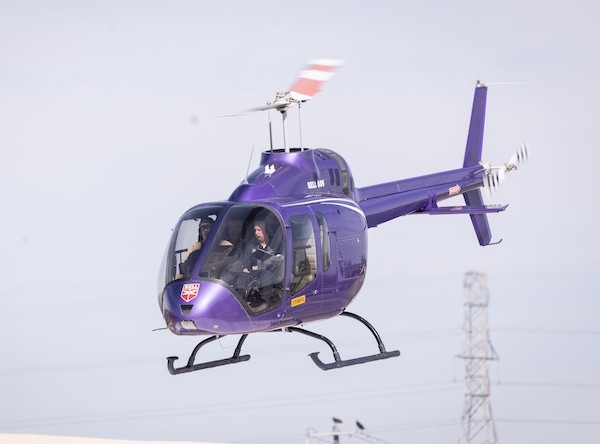
Bell 505 completed its first flight fueled solely by 100% Sustainable Aviation Fuel, marking the first-ever single engine helicopter to fly with 100% SAF. Bell collaborated with Safran Helicopter Engines, Neste, GKN Aerospace and Virent Inc. to make this Bell 505 flight possible. To achieve this flight, Bell collaborated with Safran Helicopter Engines, manufacturer of the Arrius 2R engine on the Bell 505; GKN Aerospace, the fuel system component supplier; Neste, the SAF supplier; and Virent, Inc., a Marathon Petroleum Corp. subsidiary that manufactures renewable fuels and chemicals. Safran Helicopter Engines and GKN Aerospace conducted thorough testing on the engine and fuel system components.
Michael Thacker, executive vice president, Commercial Business, Bell commented: “This flight is a monumental achievement for sustainability and decarbonization in the rotorcraft industry. Showcasing a single engine aircraft’s flight capabilities with 100% SAF signals Bell’s commitment to alternative fuel usage and builds on its sustainability practices in its flight operations.”
Valentin Safir, executive vice-president, Programs, Safran Helicopter Engines said: “SAF is one of the key pillars in our strategy to decarbonize the helicopter industry. Our engines are certified to operate on up to 50% SAF and our objective is to certify in the coming years the use of 100% SAF, which can potentially result in carbon lifecycle emissions reductions by up to 80%.”
Neste and Virent collaborated to blend, test, and deliver the SAF for this project as a 100% drop-in fuel. SAF, made from used cooking oil or other bio-based feedstocks, typically must be blended with petroleum products because it doesn’t include a component called “aromatics,” which is required to meet today’s aviation fuel specifications. Virent manufactures an aromatics component made from renewable plant sugars, which was added to Neste’s neat SAF, eliminating the need to blend SAF with petroleum fuel.The SAF supplied for this test flight by Neste and Virent is therefore a “100% drop-in” replacement for petroleum-based aviation fuel, requiring no engine modifications.
Bell own training fleet and demonstration aircraft currently use SAF in their operations. The team continues to guide customer conversations around its implementation and monitors SAF testing in a dedicated Bell 505 with Safran Helicopter Engines. This flight supports Textron’s Achieve 2025 Sustainable Footprint goal for 20% reduction in greenhouse gas emissions across the enterprise, among other sustainability initiatives.
The Bell 505 is a five-seat aircraft designed for safety and efficiency while using the most advanced technology to date. The platform uses a fully integrated Garmin G1000H NXi avionics suite and Safran Arrius 2R engine with a dual-channel FADEC.

The Star Alliance Lounge at Paris Charles de Gaulle Airport has been named the World’s Best Airline Alliance Lounge at the 2026 Skytrax World Airline Awards, securing the prestigious title for a...
Air France was among the leading winners at the Skytrax World Airline Awards, held in London on September 18, 2026, earning multiple distinctions that highlight the excellence of its products and cust...
RECARO Aircraft Seating is celebrating the 80th anniversary of Scandinavian Airlines with a unique collection of 80 customized RECARO Gaming Nxt chairs created exclusively for the carrier. Repres...
Embraer delivered the first Praetor 600E to Flexjet, marking the operator as the launch fleet customer for Embraer’s latest-generation super-midsize business jet. The inaugural aircraft joins Fl...