


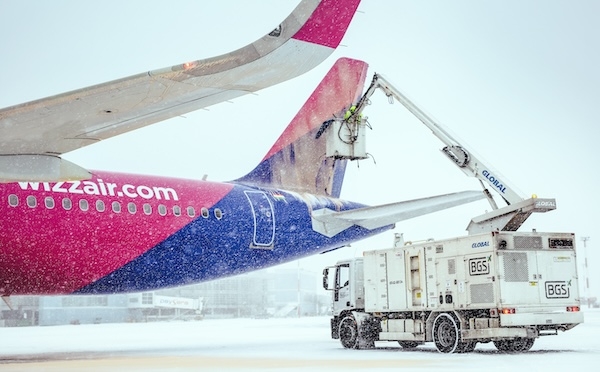
Under certain weather conditions, an aircraft requires a de-icing procedure. This procedure is most commonly used at airports during winter. Sometimes, when hot de-icing fluid is applied, causing a temperature difference, it produces visible steam. De-icing, the method used in aviation to remove ice and snow from aircraft surfaces, is inspired by space missions, these technologies were developed with the help of NASA research, seeking ways to ensure smooth operation of equipment under extreme temperatures.
During the de-icing procedure, ice, snow, or frost accumulated on the aircraft's surfaces is removed. It is essential to ensure safe takeoff and flight, as iced surfaces can disrupt aerodynamics, reduce the aircraft's stability, and affect performance.
Specialists inspect the aircraft surfaces by hand
In winter, ramp agents inspect aircraft, paying special attention to critical areas such as wings and control surfaces. This process can be challenging, because temperature fluctuations in fuel tanks may cause ice to form even when the surrounding temperature is just slightly below zero. The layer of the ice can be nearly invisible to the naked eye. To detect the ice, specialists check the aircraft's surfaces, such as the wings, by hand. Because gloves reduce tactile sensitivity, they are not used during the inspection.
De-icing fluids: different colors, different types
Special fluids are used for the de-icing procedure. Those fluids can be indicated by different bright colors. Because of the chemicals in the fluid, it has a sweet taste, but if used improperly or ingested, it can be life-threatening.
There are two main types of de-icing fluids. The difference is not only in color but also in their effect and usage. The first type is typically orange, it is used for heating and melting the ice on the aircraft surface. The second fluid, which is usually hay-colored or green and thicker, creates a protective layer that prevents new snow and ice from accumulating. After the aircraft has taken off, the de-icing fluids will safely be shed from the sprayed surfaces.
The color of the fluids helps identify which stage of the de-icing process is being performed and assess whether the procedure is being carried out correctly. This is crucial because de-icing cannot begin with the second step. This identification is necessary for ramp agents, specialists, and pilots.
The importance of weather conditions
The choice of which de-icing stage to apply and which fluid to use depends on the weather and aircraft surface conditions. The decision is made by the flight ramp agent in collaboration with the pilots. The first stage of de-icing is performed, if there is no snow or sleet and the temperature does not pose a risk of new ice or snow formation. The same stage is applied if the aircraft was parked at the airport overnight and precipitation has accumulated on its surface, but there are no other factors affecting de-icing efficiency. If significant precipitation, ice, or snow accumulates prior to takeoff, the second stage of de-icing is used.
The de-icing process is strictly controlled because it is vital for flight safety. Equipment and fluid inspections are conducted regularly. It is also important to update the procedures and organise specialist training. The de-icing specialists work with specialized equipment, requiring specific knowledge and skills and continuous updates to their expertise.
“HOT” time interval ensuring flight safety
If the aircraft cannot take off within the scheduled time, it must be de-iced again. "Holdover Time" (HOT) is the time interval during which the de-icing fluid ensures protection from ice and snow accumulation. HOT ends when the de-icing fluid loses its protective properties, and a new de-icing procedure must be performed. The HOT timetables, approved by governmental authorities, indicate how long different types of fluids can protect various weather conditions.
Key numbers
The amount of fluid used for the procedure is decided by the type of aircraft. For the first type of de-icing procedure, approximately 50 to 4,000 litres of de-icing fluid can be used. The second type of fluid is used to protect the aircraft from ice accumulation and the amount of this fluid is determined by the size of the aircraft, usually ranging from 80 to 350 litres of fluid. De-icing procedures require specialized equipment. A single de-icing truck can reach a price of €1 million.
Embraer and Japan Airlines have strengthened their long-standing collaboration through a new multi-year agreement under Embraer’s Pool Program, ensuring continued maintenance, repair, and spare-...
Embraer delivered the first Praetor 600E to Flexjet, marking the operator as the launch fleet customer for Embraer’s latest-generation super-midsize business jet. The inaugural aircraft joins Fl...
The Star Alliance Lounge at Paris Charles de Gaulle Airport has been named the World’s Best Airline Alliance Lounge at the 2026 Skytrax World Airline Awards, securing the prestigious title for a...
Confidence in Asia's business aviation market is on the rise, according to new research commissioned by Airbus Corporate Jets (ACJ). Industry experts expect demand for business aircraft to grow st...