


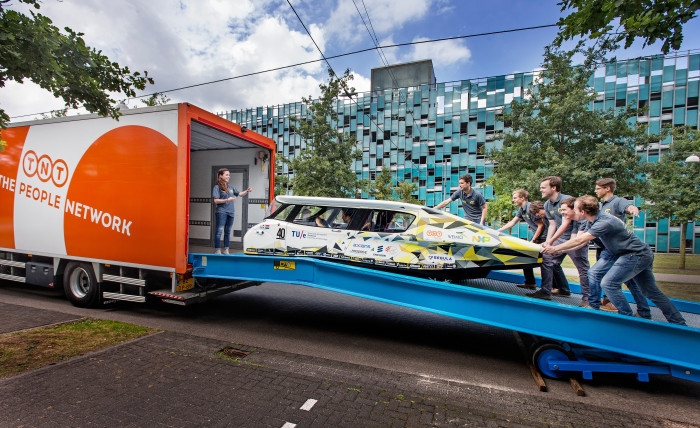
TNT has transported a prototype solar car from the Netherlands to Australia for the World Solar Challenge between 18 and 25 October.
The car, called Stella Lux, built by students at Eindhoven University of Technology, was transported by road from Eindhoven (the Netherlands) to Liege (Belgium), before flying to Singapore then Melbourne (Australia). The lithium batteries were sent by boat due to not having ready made documentation but TNT say the car and batteries arrived within a week of each other.
TNT Benelux managing director, Erik Uljee says: “We are happy to support Solar Team Eindhoven, a great team of student engineers, in winning the World Solar Challenge for the second time. Automotive is a priority industry sector for TNT and we’re glad to support research and innovation to make road transport safer and sustainable.”
Stella Lux is a wedged shaped electric car which charges itself with solar cells on its roof. The students claim the car can travel 1,000 kilometres (621 miles) on a single charge and has a top speed of 77 miles per hour. it has a navigation system to provide route guidance based on weather predictions. The race will cover 3,000 kilometres between the Australian cities of Darwin and Adelaide.
Embraer delivered the first Praetor 600E to Flexjet, marking the operator as the launch fleet customer for Embraer’s latest-generation super-midsize business jet. The inaugural aircraft joins Fl...
Embraer and Japan Airlines have strengthened their long-standing collaboration through a new multi-year agreement under Embraer’s Pool Program, ensuring continued maintenance, repair, and spare-...
KlasJet has achieved a significant milestone by obtaining Part 129 Operations Specifications (OpSpecs) approval from the FAA, paving the way for the company's expansion into the U.S. market. As pa...
ALSIM has announced that MH Cockpit, based in India, has acquired an AL250 simulator—marking a significant step in MH Cockpit’s expansion plans and reinforcing its ambition to build a robu...