


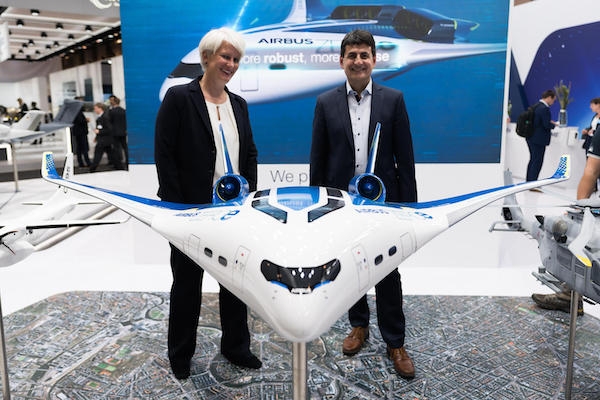
Airbus and Linde have signed a Memorandum of Understanding (MoU) to work on the development of hydrogen infrastructure at airports worldwide. The agreement follows a cooperation agreement signed in Singapore in February and covers collaboration on global supply chains for hydrogen, from production to airport storage, including the integration of refuelling into normal ground handling operations. Both companies will define and launch pilot projects at several airports from early 2023 onwards. In addition, Airbus and Linde will analyse the potential of Power-to-Liquid fuels - a type of Sustainable Aviation Fuel (SAF) made from the synthetically produced liquid hydrocarbon through the conversion of renewable electricity.
"We are advancing well with hydrogen as an important technology pathway to achieve our ambition of bringing a zero-emission commercial aircraft to market by 2035. Building the infrastructure is just as crucial. That's why we are working closely with partners like Linde, who have decades of experience and expertise worldwide in the storage and distribution of hydrogen," said Sabine Klauke, Chief Technical Officer, Airbus.
“We are pleased to expand our successful collaboration with Airbus to a global scope,” said Philippe Peccard, Vice President Clean Energy, Linde. “By harnessing both companies’ competencies we are well positioned to collaborate with airports and government authorities in the development of viable concepts for sustainable airport hubs based on hydrogen.”
The use of hydrogen to power future aircraft is not only expected to significantly reduce aircraft emissions in the air, but could also help decarbonise air transport activities on the ground. In 2020 Airbus launched the “Hydrogen Hub at Airports” programme to jumpstart research into infrastructure requirements and low-carbon airport operations, across the entire value chain. To date agreements have been signed with partners and airports in France, Italy, South Korea, Japan and Singapore.
The first ZEROe concept aircraft were unveiled in 2020, and development of the corresponding technology bricks is now underway in a global R&T network focused on developing the hydrogen technology for future commercial aircraft.
To find out more about hydrogen and decarbonisation visit www.airbus.com.
KlasJet has achieved a significant milestone by obtaining Part 129 Operations Specifications (OpSpecs) approval from the FAA, paving the way for the company's expansion into the U.S. market. As pa...
The Fuerza Aérea Mexicana has announced the acquisition of a second Lockheed Martin C-130J-30 Super Hercules tactical airlifter, further strengthening Mexico's position...
Embraer delivered the first Praetor 600E to Flexjet, marking the operator as the launch fleet customer for Embraer’s latest-generation super-midsize business jet. The inaugural aircraft joins Fl...
The year of the P.180 Avanti’s 40th anniversary has brought a second reason for celebration at Piaggio Aerospace: the sale of more than 40 P.180 Avanti EVO aircraft since the model entered servi...