


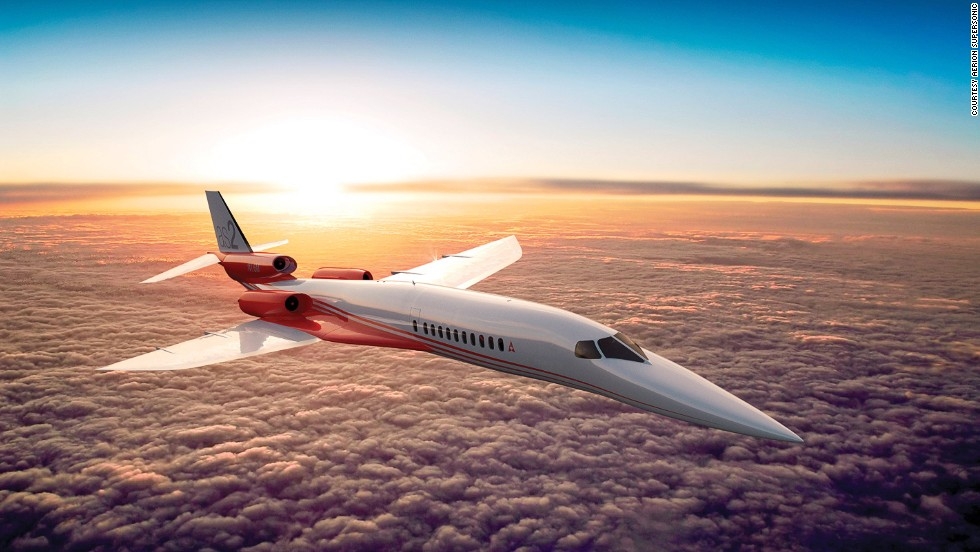
Aerion announced its first firm order for its AS2 at NBAA”s Business Aviation Convention & Exhibition (NBAA2015) on Nov. 17, bringing the supersonic business jet closer to reality. Now, some experts think the supersonic age is set to take off.

“This time, what we have is real. I believe we will see a supersonic business jet by 2023,” said Oscar Garcia, chairman of InterFlight Global Corporation at NBAA2015, estimating 40 to 100 letters of intent for the AS2 have been received, including the 20-unit order by Flexjet announced earlier at the show.
Off and on for 20 years, manufacturers such as Gulfstream, Sukhoi and Dassault have attempted to move supersonic aircraft past the design stage, but none have taken over for the Concorde since 2003.
Today, Garcia and the engineers at Aerion, with their partners at Airbus, are bullish because of developments in laminar flow wings and ramjet engines.
Shrinking the World
With today”s fastest, ultra-long-range business aircraft, such as the Gulfstream G650 and Global 6000, a flight from Los Angeles to Tokyo takes 12 hours. Those airplanes could cover the world in four days.
“So, the size of the world is four days,” said Garcia.
As the Honeywell Global Business Aviation Outlook, just released at NBAA2015, revealed, demand for ultra-high-speed, ultra-long-range aircraft continues to outpace other categories. “What buyers want is minimal time on the aircraft,” said Garcia, “and more time at their destination.”
At supersonic speeds, approaching Mach 2, an aircraft could cover the world in 17 hours with one or two stops, “so the size of the world is two days,” said Garcia. For supersonic business aircraft to find a market, though, they”d have to meet several challenges:
The environmental footprint is key, explained Garcia, especially in terms of noise and emissions. “We cannot have a breakthrough with speed at the expense of all the other breakthroughs we, as an industry, have worked so hard to achieve,” he said, emphasizing that supersonic aircraft will have to be compliant with Stage 4 noise standards.
Hypersonic and the Edge of Space
While supersonic business airplanes may be a reality soon, “there”s nothing today that achieves hypersonic speeds, of Mach 2 to 5,” said Garcia, although he predicted that in 10 to 15 years, there might be.
The challenges for hypersonic travel are greater, with no engine yet invented, except those used by the military, to power those speeds.
Such an aircraft would fly at the edge of space, in “airspace that no civil aviation authority yet understands,” and have serious cabin pressure issues.
Garcia also predicted that by 2050, a suborbital business aircraft might be feasible, possibly modeled on Virgin Galactic”s SpaceShipTwo or the EADS Space Plane, that could travel anywhere on earth in two hours.
“Supersonic, hypersonic and suborbital commercial air travel with begin with business aircraft,” said Garcia. It makes sense. Many users say a business airplane is like a time machine, and “people can buy anything but time.”

The Star Alliance Lounge at Paris Charles de Gaulle Airport has been named the World’s Best Airline Alliance Lounge at the 2026 Skytrax World Airline Awards, securing the prestigious title for a...
Embraer and Japan Airlines have strengthened their long-standing collaboration through a new multi-year agreement under Embraer’s Pool Program, ensuring continued maintenance, repair, and spare-...
Air France was among the leading winners at the Skytrax World Airline Awards, held in London on September 18, 2026, earning multiple distinctions that highlight the excellence of its products and cust...
flydubai has strengthened its pilot development strategy through new partnerships with Egnatia Aviation and Skyborne Airline Academy, aimed at expanding the airline's training capacity and support...