


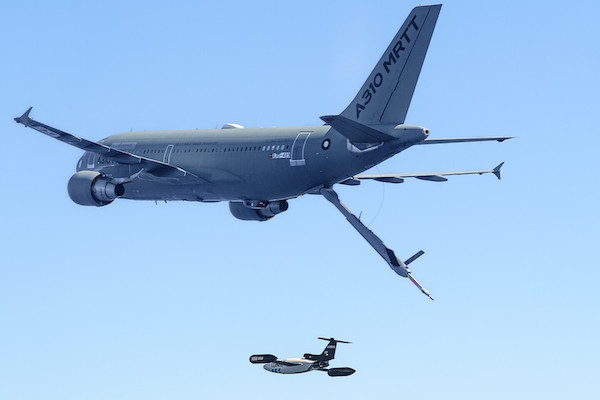
Airbus Defence and Space and Airbus UpNext achieved in-flight autonomous guidance and control of a drone using an A310 MRTT. In a first step towards Autonomous Formation Flight and Autonomous Air-to-Air refuelling (A4R), the technologies demonstrate a significant breakthrough for future aerial operations involving manned and unmanned assets. These cutting-edge, ‘Made in Europe’ solutions could reduce crew fatigue and the potential for human error, as well as minimising crew-training costs and providing more effective operations.
Jean Brice Dumont, Head of Military Air Systems at Airbus Defence and Space, commented: “The success of this first flight-test campaign paves the way for developing autonomous and unmanned air-to-air refuelling technologies. Even though we are at an early stage, we have achieved this within just one year and are on the right track for manned-unmanned teaming and future air force operations where fighters and mission aircraft will fly jointly with drone swarms.”
Known as Auto’Mate, the technologies were integrated on an A310 MRTT flying testbed, which took off from Getafe, Spain, on 21 March, and on several DT-25 target drones, acting as receiver aircraft and flying from Arenosillo Test Centre (CEDEA) at Huelva, Spain. Over the waters of the Gulf of Cadiz, the control of the drone transitioned from a ground station to the A310 MRTT, autonomously guiding the DT-25 to the in-flight refuelling position.
During almost six hours of flight test, the four successively launched receivers were sequentially controlled and commanded thanks to artificial intelligence and cooperative control algorithms, without human interaction. The different receivers were controlled and guided until a minimum distance of 150 feet (around 45 metres) from the A310 MRTT.
Auto’Mate Demonstrator technology focuses on three pillars:
These pioneering technologies, developed by a European team from Spain, Germany and France, will continue to increase the capability gap among competitors, as well as being re-used in key technological projects, such as the Future Combat Air System (FCAS).
A second campaign is expected towards the end of 2023, exploring the use of navigation sensors based on artificial intelligence and enhanced algorithms for autonomous formation flight. In addition, there will also be two simulated drones flying in the vicinity of the A310 MRTT to demonstrate multi-receiver autonomous operations and collision-avoidance algorithms.
Embraer and Japan Airlines have strengthened their long-standing collaboration through a new multi-year agreement under Embraer’s Pool Program, ensuring continued maintenance, repair, and spare-...
TARMAC Aerosave, Europe’s leading provider of aircraft storage, maintenance and recycling services, announced today at MRO Asia-Pacific 2026 that it has received approval (IND.FAMO.0000000129) f...
RECARO Aircraft Seating is celebrating the 80th anniversary of Scandinavian Airlines with a unique collection of 80 customized RECARO Gaming Nxt chairs created exclusively for the carrier. Repres...
Aviation evolves through moments of clarity — moments when industry leaders step forward to explain not only what is happening, but why it matters. This conversation with Evgeny Shadov, VP ...