

Small talk with Alexander Gerst on board the ISS makes aerospace history
@AirbusSpace @DLR_en @Space_Station @Astro_Alex #horizons #ISS #AI
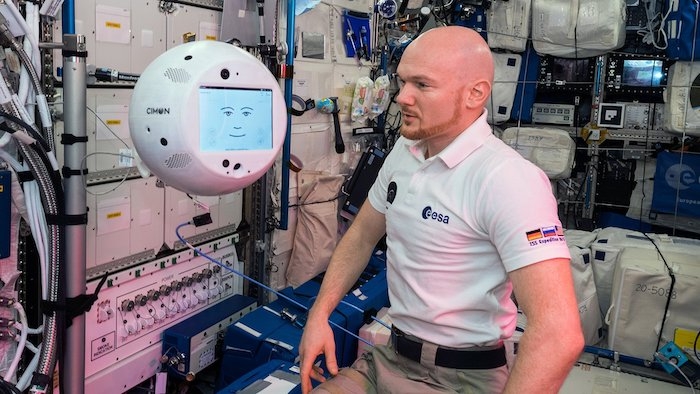
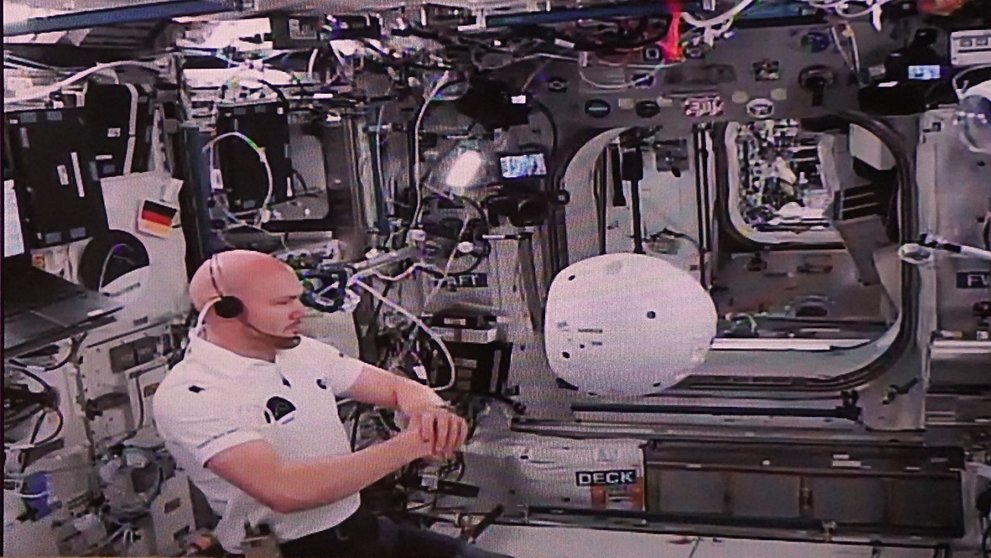
The astronaut assistant, CIMON* (Crew Interactive Mobile CompanioN), developed and built by Airbus on behalf of the German Aerospace Center (DLR), has passed its first tests in space with flying colours. It worked together with German ESA astronaut, Alexander Gerst, in the Columbus module of the International Space Station (ISS) for around 90 minutes.
Gerst has been living and working on the ISS since 8 June 2018. His current horizons mission, lasting six months, includes conducting a series of tests with CIMON. This medicine-ball-sized plastic sphere, which weighs five kilogrammes, was created using 3D printing and is the first AI-based astronaut assistant – an experimental technology studying human-machine interaction in space.
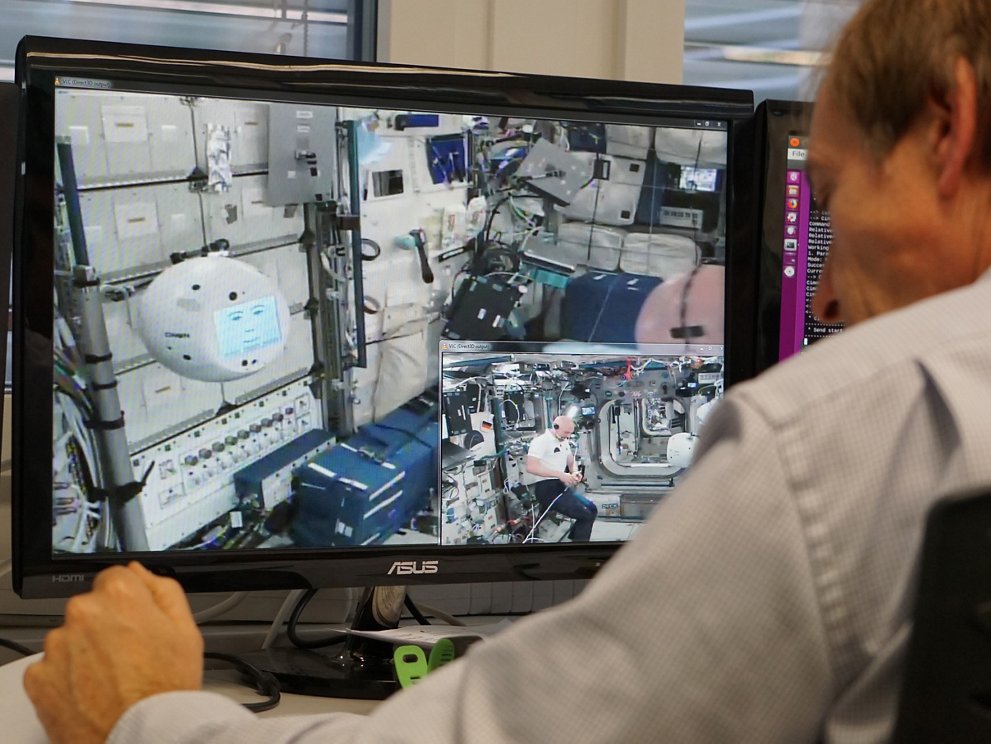
At 11:40 h CET on 15 November 2018, the German-Swiss CIMON mission team at Lucerne University’s BIOTESC ground control centre in Switzerland waited with bated breath. After two and a half years of intense preparation and countless hours of training, it was so quiet you could have heard a pin drop, the air thick with intense concentration and joyful anticipation. Following a software upload to the ISS and a software update for CIMON itself, an audio check and a test of the navigation camera, Alexander Gerst finally came face to ‘face’ with his new artificial roommate, activating it for the very first time. The first ‘meeting’ between the German ESA astronaut and the free-flying robotic crew assistant, a world first, lasted 90 minutes.
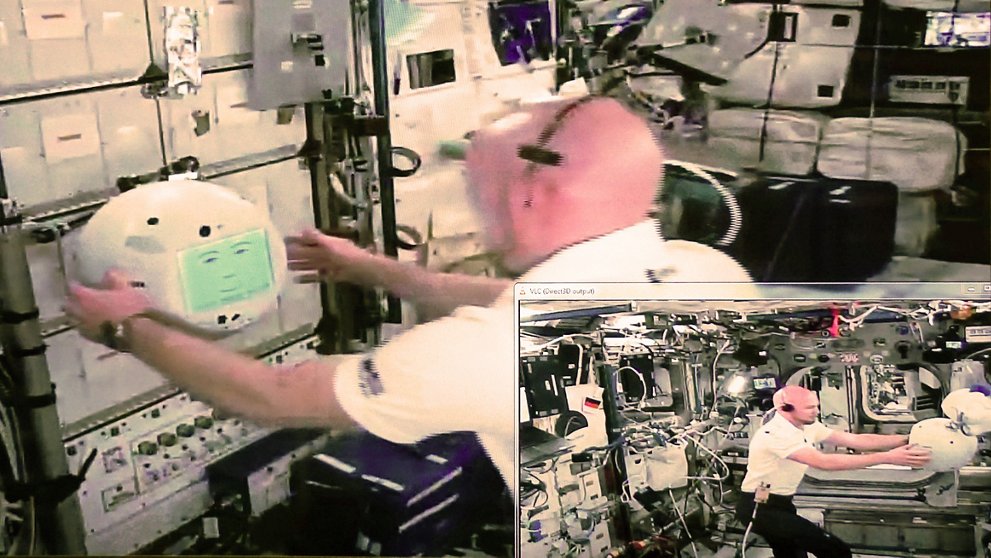
CIMON’s autonomous navigation was then tested, seeing the assistant perform several turns and movements in every direction. It was able to search for Gerst’s face and make ‘eye’ contact. As a demonstration of its assistance capabilities, CIMON displayed instructions for a school science experiment on crystallisation and a video of the Rubik’s cube puzzle on its ‘face’, a screen set in the centre of the sphere, and played a piece of music. It then tested its ultrasonic sensors, which have a similar function to a car’s parking sensors, and took a photo and shot a video of Gerst using its integrated cameras. Finally, Gerst returned his crew assistant to its place in the Columbus module.
“CIMON represents the realisation of an Airbus vision. It is a huge step forward for human space flight, achieved by working in cooperation with our partners. With CIMON, we have laid the foundations for social assistance systems that are designed to be used under extreme conditions,” said Till Eisenberg, CIMON Project Manager at Airbus.
“It is an incredible feeling and absolutely fantastic to be able to experience CIMON actually seeing, hearing, understanding and speaking. This first, real deployment in space has made aerospace history, and marks the start of what will hopefully be a long deployment on the ISS,” said Dr Christian Karrasch, CIMON Project Manager at the DLR Space Agency. “I am fascinated by interactions with artificial intelligence. The CIMON system is the only one of its kind, and was designed specifically for deployment on the International Space Station. We are entering uncharted territory and pushing the boundaries of technological expertise in Germany.”
CIMON uses the Wi-Fi on the ISS to transmit data, making use of satellite connections to ground stations to establish an internet connection with the IBM Cloud. Matthias Biniok, IBM project lead, explained the processes that then take place in CIMON’s ‘brain’: “If CIMON is asked a question or addressed, the Watson AI firstly converts this audio signal into text, which is understood, or interpreted, by the AI. IBM Watson not only understands content in context, it can also understand the intention behind it. The result is a tailored answer, which is converted into speech and then sent back to the ISS, enabling a natural, dynamic spoken dialogue.”
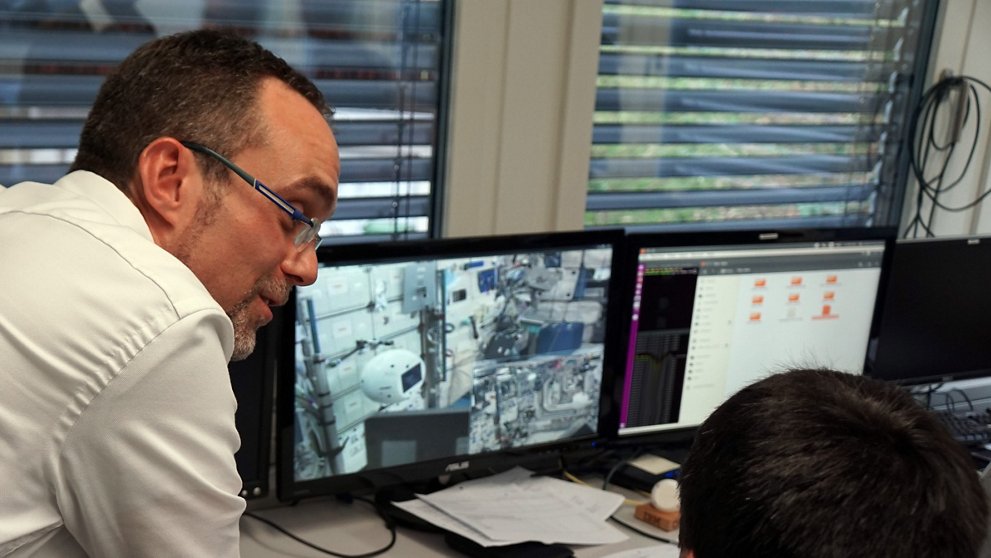
Bernd Rattenbacher, team leader at the ground control centre at Lucerne University, said: “The data link to Earth is established via satellite to NASA/ESA and to the DLR’s Columbus control centre in Oberpfaffenhofen, Germany. From there, the signal is transmitted to us, the CIMON ground station at BIOTESC in Lucerne, the Swiss User Support and Operations Center, which is connected to the IBM Cloud in Frankfurt over the internet. The time needed for the signal to be transmitted via satellite is 0.4 seconds each way. A number of firewalls and VPN tunnels are in place to ensure data security.”
CIMON also has a scientific background: its advisors are Dr Judith-Irina Buchheim and Professor Alexander Choukèr from the Department of Anaesthesiology at the Ludwig-Maximilian University Hospital in Munich. Buchheim said: “As a partner and assistant, CIMON could support astronauts with their high workload of experiments and maintenance and repair work, thereby reducing their exposure to stress.”
Neste and United Airlines have extended their agreement for the supply of sustainable aviation fuel, blended with conventional jet fuel, for flights departing from Chicago O’Hare International A...
Embraer and Japan Airlines have strengthened their long-standing collaboration through a new multi-year agreement under Embraer’s Pool Program, ensuring continued maintenance, repair, and spare-...
Boeing and Korean Air announced that the carrier has finalized a purchase agreement for 103 aircraft spanning Boeing’s widebody and single‑aisle families. The deal includes 20 777‑9, 25 787...
KlasJet has achieved a significant milestone by obtaining Part 129 Operations Specifications (OpSpecs) approval from the FAA, paving the way for the company's expansion into the U.S. market. As pa...