


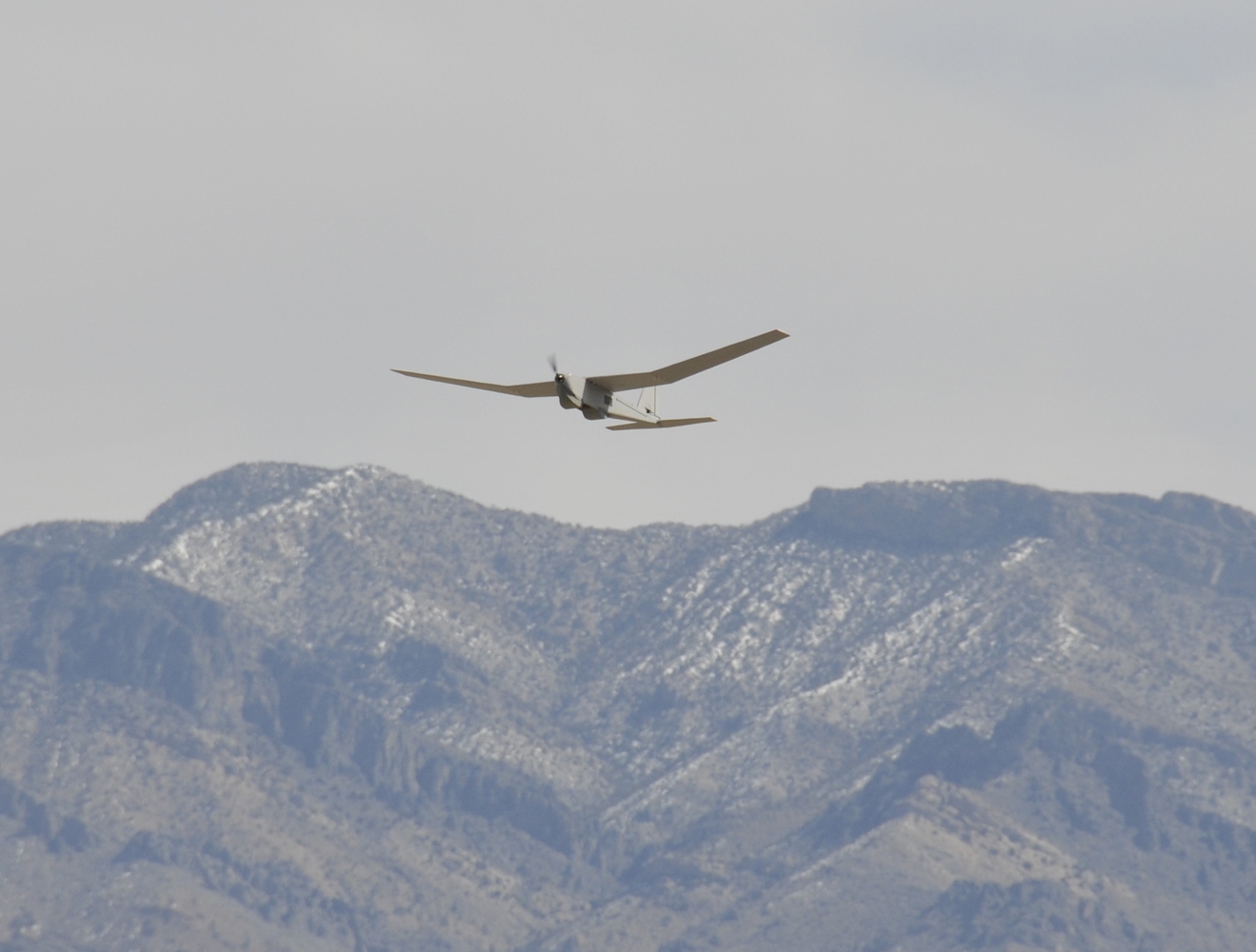
The National Oceanic and Atmospheric Administration (NOAA) has completed the first deployment of the AeroVironment RQ-20A Puma AE unmanned air vehicle to the Antarctic, where it supported a US Coast Guard resupply mission.
It operated onboard the US Coast Guard icebreaker Polar Star in support of the annual operation Deep Freeze deployment, taking on the role of manned helicopters in providing reconnaissance during the first deployment of a UAV in the Antarctic by NOAA.
“Our mission was to fly ahead of the ship, a role usually taken by manned helicopters and a dangerous one to carry out,” Todd Jacobs, project scientist for unmanned air systems at NOAA, told a media at the AUVSI Xponential exhibition in New Orleans, Louisiana this week.
The type has previously been deployed by NOAA in the Arctic. Jacobs notes that of the different types the administration has deployed in support of these operations, the Puma and Insitu ScanEagle are the only ones that have proven viable.
He attributes the rugged capability of the system to its success in this environment, plus the ease of flight authorisation as a result of the military clearances that it has gained from US operations. During the deployment, 20 flights were carried out to collect 12h of video data, and the system demonstrated autonomous ship landings.
Puma AE
AeroVironment
NOAA owns two Puma AE systems, each consisting of three aircraft plus control systems.
The system was operated beyond line of sight under a federal “due regard” law, which contributed to it replacing the manned helicopters in this role.
In addition to the reconnaissance mission, the Puma was also used to carry out surveillance for the US’ national ice centre, and deployed with the Puma’s new Mantis i45 electro-optical/infrared payload that was first introduced during the Xponential show.
Deep Freeze is supported by a number of manned aircraft, including the Lockheed Martin C-130J and Boeing C-17 transports, which the Puma had to deconflict with.
The UAV has to remain at a safe separation distance from the manned aircraft to ensure there was no chance of collision. Other challenges included not being able to operate in high winds; the Puma can only fly in winds up to 35kt.
While Jacobs says that the deployment was a success, it is yet to be decided if the system will carry out the mission again during the next annual exercise.
Embraer delivered the first Praetor 600E to Flexjet, marking the operator as the launch fleet customer for Embraer’s latest-generation super-midsize business jet. The inaugural aircraft joins Fl...
ALSIM has announced that MH Cockpit, based in India, has acquired an AL250 simulator—marking a significant step in MH Cockpit’s expansion plans and reinforcing its ambition to build a robu...
Embraer and Japan Airlines have strengthened their long-standing collaboration through a new multi-year agreement under Embraer’s Pool Program, ensuring continued maintenance, repair, and spare-...
Air France was among the leading winners at the Skytrax World Airline Awards, held in London on September 18, 2026, earning multiple distinctions that highlight the excellence of its products and cust...