


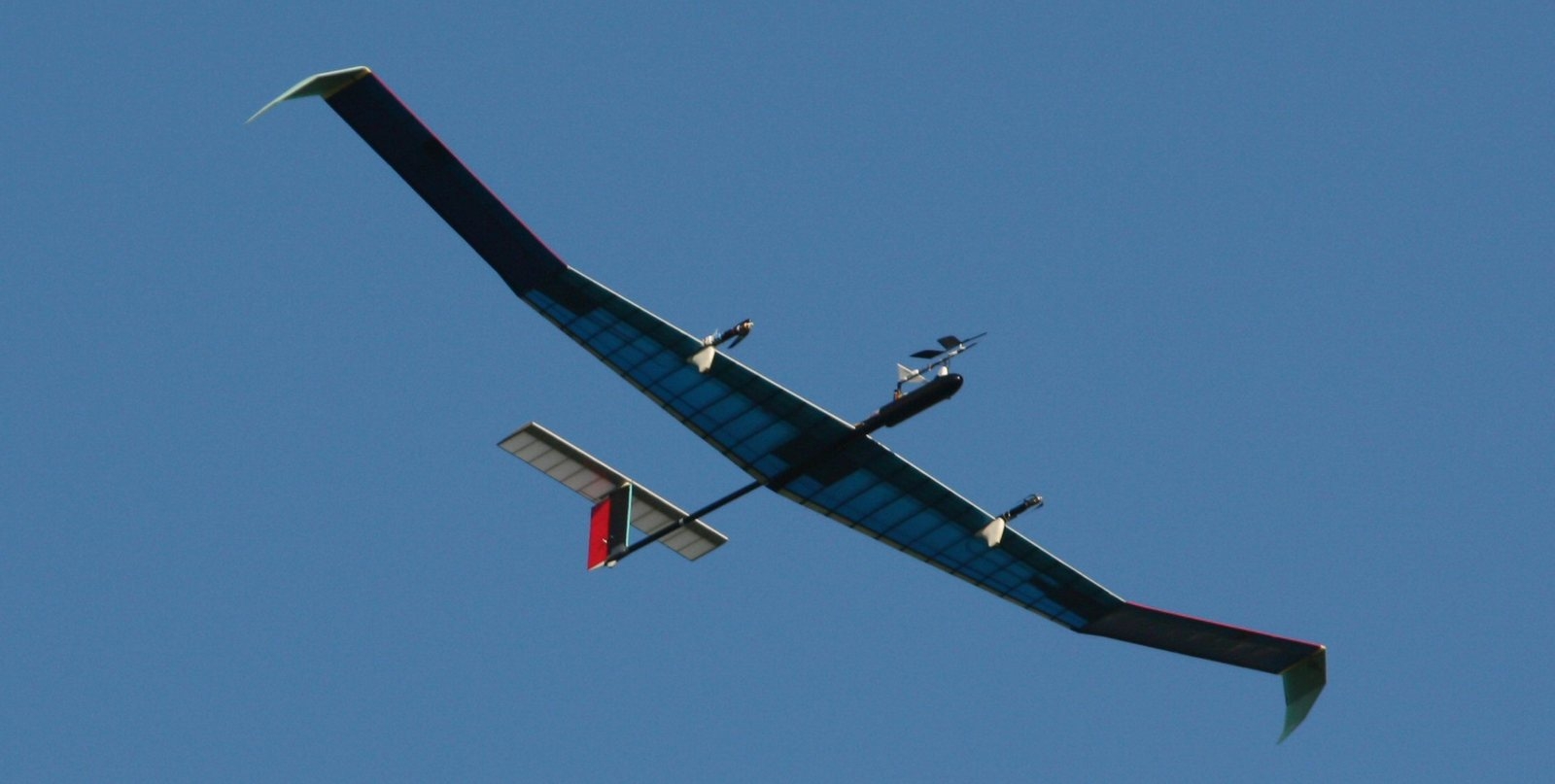
Roke Manor has been contracted under the UK’s Defence Growth Partnership (DGP) to develop a communications payload for high-altitude unmanned air vehicles. The system is being developed with the Airbus Defence & Space Zephyr pseudo satellite in mind.
Airbus Defence & Space
While not intended exclusively for integration with Zephyr, due to the export focus of the DGP, the high-altitude pseudo satellite was considered during the design of the High Altitude Cellular Communications payload, and Roke is keen for it to be tested using the long-endurance aircraft.
“Although the Zephyr is an obvious candidate, we anticipate other countries will at some stage in the near future be creating similar offerings,” Bob Dalgleish, business development manager for space and defence at Roke, says. “The Zephyr platform is a logical vehicle for this technology, however, given its ability to provide persistent surveillance from 60,000ft.”
He adds that the proposed sensor system takes into consideration the Zephyr’s size, weight and power constraints, but the company is interested in utilising the technology on board a range of suitable UAVs.
The data link payload will communicate with ground-based cellular infrastructure at a distance of 50km, transmitting high-bandwidth, real-time images and video, using commercial off-the-shelf 3G systems, alongside beamforming technology to transmit to a defined point.
The new payload activity was announced by Roke on 9 December, and follows a contract award made under the DGP Defence Solutions Centre’s (DSC) £10 million ($15 million) Innovation Challenge on 15 October. The first phase of work will result in a concept demonstration, which is expected to occur at the end of January.
Dalgleish says Roke will compete for the second phase of the effort – in mid-2016 – which is expected to result in a fully-working prototype by the end of the same year.
“Within the UK, since the Ministry of Defence has funded this DSC call, we hope that our technology will be taken forwards in a funded UK MoD demonstration programme involving high-altitude, long-endurance UAV platforms, which may or may not be the Zephyr vehicle itself,” Dalgleish says. With the correct funding, an airworthy demonstration could take place within 12-18 months, he adds.
The UK government announced in November's Strategic Defence and Security Review that it was committing "investment in advanced high-altitude surveillance aircraft”; a reference which is understood to have concerned the Zephyr.
The Star Alliance Lounge at Paris Charles de Gaulle Airport has been named the World’s Best Airline Alliance Lounge at the 2026 Skytrax World Airline Awards, securing the prestigious title for a...
ExecuJet MRO Services Australia successfully completed a major 20-year scheduled airframe inspection on an Indonesian-registered Embraer Legacy 600 at its Sydney facility, further demonstrating t...
Embraer delivered the first Praetor 600E to Flexjet, marking the operator as the launch fleet customer for Embraer’s latest-generation super-midsize business jet. The inaugural aircraft joins Fl...
Embraer and Japan Airlines have strengthened their long-standing collaboration through a new multi-year agreement under Embraer’s Pool Program, ensuring continued maintenance, repair, and spare-...