


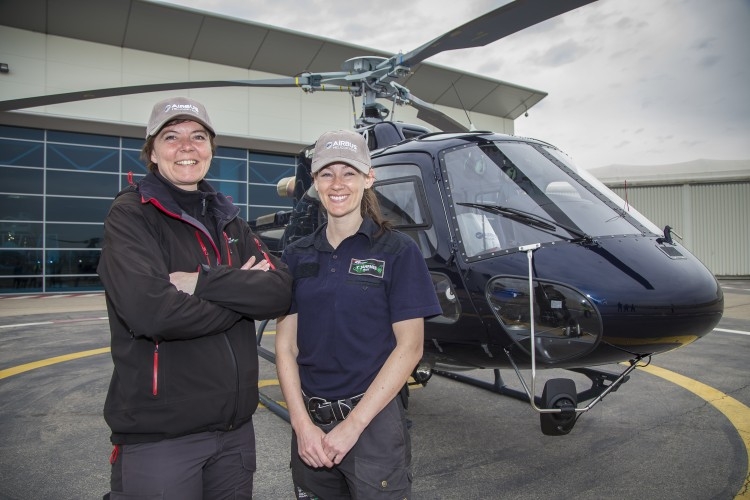
On May 30, 2016, Norwegian aerial work and passenger transport provider Nor Aviation received its third H125 in Marignane, France. On the occasion of the delivery, female flight operations manager and pilot Aga Tone sat down to chat with Airbus Helicopters about her experience as a woman in the helicopter world.

What led you to become a helicopter pilot?
My father was an avionics technician in the Norwegian air force so I grew up with helicopters, in the helicopters hangar, and like many people I thought that becoming a pilot was not something you could do. Pilots, they had to be some sort of super humans.
I first started my education in tax law and law, then I soon realized I didn’t want to become a lawyer or work with taxes for the rest of my life. I found a civilian helicopter school, so I applied. I was not, say old, but I was 27 when I first started flying compared to the others who were around 18.
What are the abilities required to be an excellent helicopter pilot?
There a lot of skills required, but I think, especially for a helicopter pilot, you need to be able to work on your own, to be independent, and be self-aware, know yourself, your limits, because if you’re over or under confident, either way you have a problem. And, of course, being able to push yourself because otherwise you will never broaden your horizons enough to go anywhere.
Would you say that it’s hard for a woman to be in a man’s world?
That’s a very interesting question and I ask myself that because of course in Norway, women are equal, and we are given the same opportunities. It’s not like I wasn’t allowed to go to school and become a pilot, but sometimes I feel like I’m struggling to be accepted and then I’m not sure if it’s because I’m a women or because I’m me, if it’s my personality or my gender. And there are too few women to make assumptions based on gender.
When I spent four months in India, I was very worried that I would be discriminated against as a woman, but in fact for the first time in my life I was actually treated the same way as my male colleagues, and it was a huge surprise to me. In India, they have many female pilots. I had fair skin and was tall – that was strange – but that I was not a male that wasn’t.
Here, because it’s uncommon, I don’t get the same treatment as a man. I wouldn’t call it discrimination, but there is something. I think that any profession if it’s dominated by only one gender, it’s not good, either way.

ExecuJet MRO Services Australia successfully completed a major 20-year scheduled airframe inspection on an Indonesian-registered Embraer Legacy 600 at its Sydney facility, further demonstrating t...
Embraer and Japan Airlines have strengthened their long-standing collaboration through a new multi-year agreement under Embraer’s Pool Program, ensuring continued maintenance, repair, and spare-...
Embraer delivered the first Praetor 600E to Flexjet, marking the operator as the launch fleet customer for Embraer’s latest-generation super-midsize business jet. The inaugural aircraft joins Fl...
Confidence in Asia's business aviation market is on the rise, according to new research commissioned by Airbus Corporate Jets (ACJ). Industry experts expect demand for business aircraft to grow st...